Home-Style Dishes
Morinda, Walnut & Sea Cucumber Stew
Traditionally used to warm and nourish the kidneys and support fertility
Why people make this stew
In Chinese tradition the kidneys are seen as the body’s “root,” governing growth, development and reproduction; when kidney yang is weak or kidney essence depleted, this is thought to show as cold limbs, frequent urination, lower-back soreness, dizziness, ringing ears and fatigue. Everyday food therapy uses warming, kidney-nourishing foods to support this. This morinda, walnut and sea cucumber stew is traditionally valued to warm and nourish essence and blood and support the kidneys — and is favored by couples hoping to conceive.
Who it suits / who should be cautious
- Couples hoping to conceive; also traditionally favored by older adults with kidney-deficiency signs such as poor hearing, forgetfulness or a weak lower back and knees
- Sea cucumber is regarded as nourishing both kidney yin and yang, so it suits both men and women
- If you tend to run “heaty,” adding nan zao and yu zhu makes the stew less drying; avoid during pregnancy unless professionally guided
Why these ingredients (the food-therapy logic)
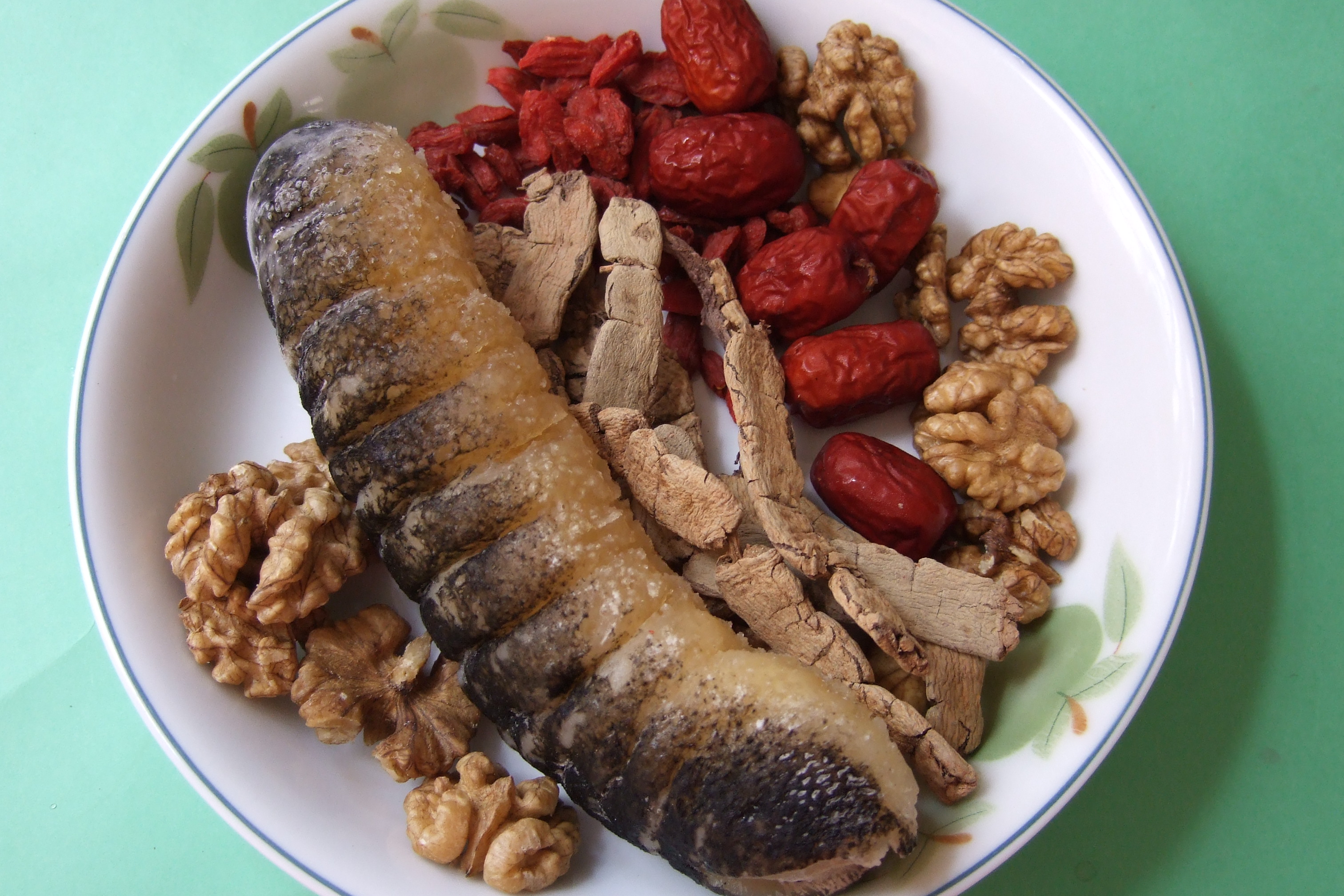
- Morinda root (ba ji): a herb traditionally associated with warming and supporting the kidneys
- Walnut (he tao rou): traditionally used to support the kidneys and lungs
- Goji berry (gou qi zi): associated with nourishing the liver and kidneys
- Red dates (hong zao): nourish the blood and round out the stew
- Sea cucumber (hai shen): regarded as nourishing both kidney yin and yang, and traditionally favored for fertility
Ingredients (2 bowls)
| Ingredient | Amount | Notes |
|---|---|---|
| Morinda root (ba ji) | ~38 g (1 liang) | Soak and rinse |
| Walnuts (he tao rou) | ~75 g (2 liang) | Soak and rinse |
| Goji berries (gou qi zi) | ~19 g (5 qian) | Soak and rinse |
| Red dates (hong zao) | 6 | Pitted |
| Re-hydrated sea cucumber (hai shen) | ~150 g (4 liang) | Blanch, cut into segments |
Method
- Soak and rinse the morinda, goji berries, red dates and walnuts.
- Blanch the re-hydrated sea cucumber and cut into segments.
- Put everything in a stewing pot, add about 4 bowls of boiling water, and double-boil (steam over water) about 3 hours. Drink the soup and eat the sea cucumber.
Bro Niu’s tips
This stew is also traditionally favored by older adults with kidney-deficiency signs such as poor hearing, forgetfulness and weak lower back and knees. To make it less drying for those who run “heaty,” add 6 nan zao (southern dates) and ~11 g yu zhu (Solomon’s seal). Re-hydrate the sea cucumber in room-temperature water.
Community questions answered (selected)
- Q (Sophia): Besides double-boiling, can this morinda-walnut-sea cucumber be simmered in a regular pot? Same effect? How long, and how many times a week if hoping to conceive? Bro Niu: You can simmer it, but watch it doesn’t stick, since sea cucumber is rich in gelatin. Simmering and double-boiling have the same effect — twice or three times a week, about an hour and a half by simmering.
- Q (Susan): I miscarried in Dec 2014 and July 2015; my doctor of Chinese medicine says I’m blood- and qi-deficient. I’m 37 and hoping for another child — can my husband and I drink this soup together? Bro Niu: You and your husband can both drink it. Sea cucumber is a both-ways nourishing food — nourishing to both kidney yin and yang — so it suits men and women. Try to have at least two sea cucumbers each per week. For blood- and qi-deficiency it’s best to see a doctor of Chinese medicine for tailored care.
- Q (reader): Can rou cong rong be used in place of ba ji? Same effect? Bro Niu: Both rou cong rong and ba ji are herbs traditionally associated with supporting kidney yang; rou cong rong is also moistening and traditionally favored for dryness-type constipation.
Published August 31, 2010 · Adapted and translated for Nourilo from a traditional home-kitchen recipe. Approx. 3 min read.