Soups
Fresh Morinda, Chestnut and Pork Bone Soup
traditionally used to support kidney qi, strengthen bones, and nourish memory
Why people make this soup
In classical Chinese medicine, the kidneys are seen as the root of the body’s vitality — they govern the bones, store essence, and support hearing, memory, and reproductive health. When kidney qi runs low, people often notice gradual lower-back achiness, fatigue, frequent night urination, or decreased concentration. This is especially common around menopause in women and as men age past fifty. Bro Niu uses fresh morinda root as the cornerstone of this soup because it gently warms kidney yang without being harsh. Combined with chestnuts, walnuts, and black soybeans — all traditionally regarded as kidney-supportive foods — the result is a richly flavoured soup that is as practical as it is nourishing.
Who it suits / who should be cautious
- Suitable for most adults and older children; the whole family can share this soup.
- Particularly helpful for those with lower-back fatigue, mild memory decline, or reduced concentration.
- People with a hot constitution (frequent thirst, red face, feeling of internal heat) should not take morinda regularly; substitute Chinese yam (huai shan) if needed.
- Do not take during a cold or fever — warming herbs are best avoided when the body is fighting an active infection.
- Those with gout should replace the black soybeans with red adzuki beans (chi xiao dou), which help the body process uric acid.
- Pregnant women: black soybean water is fine during pregnancy, but avoid coix (yi mi / barley) — it can cause uterine contractions.
Why these ingredients (the food-therapy logic)
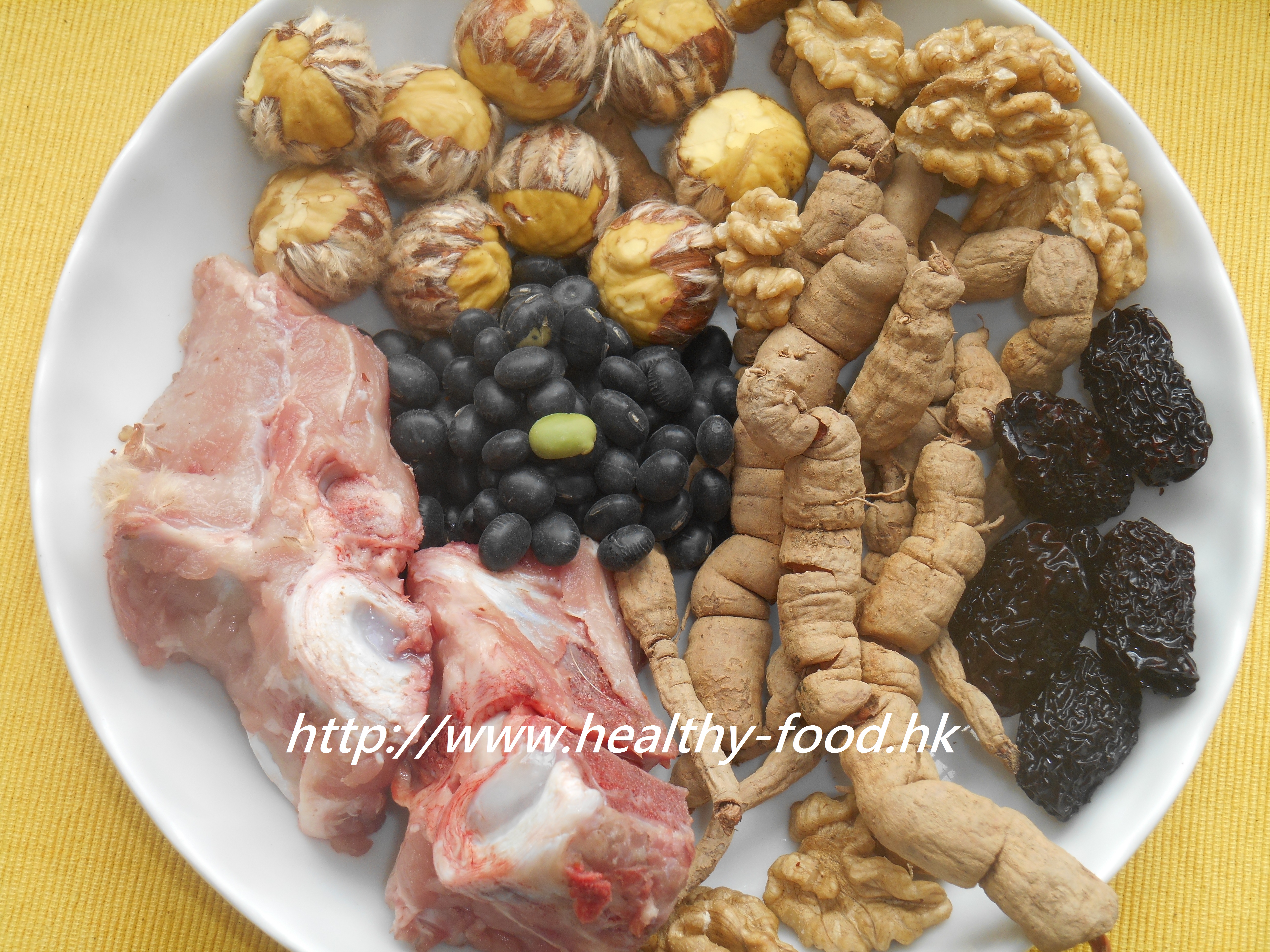
- Morinda root (ba ji, Morinda officinalis): A classical tonic for kidney yang; traditionally associated with relieving lower-back and knee aching, reducing night urination, and supporting reproductive vitality in both men and women.
- Chestnut (li zi): Warming; in traditional thinking it “nourishes the kidney, strengthens the sinews, and supports the lower back.” Can be replaced with black beans or cashews when unavailable.
- Black soybean (qing ren hei dou): Traditionally seen as the kidney’s companion among legumes; associated with nourishing yin, improving circulation, and supporting hair and eyesight.
- Walnut kernel (he tao rou): Considered a brain and kidney tonic in Chinese food therapy; rich in healthy fats and associated with improving memory and concentration.
- Red dates (nan zao): Harmonise the formula, support blood, and improve flavour. Those with diabetes may drink the broth without eating the dates.
- Pork bones: Provide a rich, collagen-containing base; traditionally used to support bone health.
Ingredients (4–5 bowls)
| Ingredient | Amount | Notes |
|---|---|---|
| Fresh morinda root (xian ba ji) | ~75 g | Soaked, rinsed, cut into sections; use 20 g dried if unavailable |
| Chestnuts (li zi) | ~115 g | Blanched, peeled; replace with cashews or black beans in summer |
| Black soybeans with green core (qing ren hei dou) | ~40 g | Soaked and rinsed; replace with adzuki beans for gout |
| Walnut kernels (he tao rou) | ~40 g | Soaked and rinsed |
| Chinese red dates (nan zao) | 6 pieces | |
| Pork bones (zhu gu) | ~450 g | Blanched in boiling water, rinsed |
| Water | 10 bowls (~2 L) |
Method
- Blanch pork bones in boiling water for 3–5 minutes; drain and rinse under cold water to remove impurities.
- Soak fresh morinda root in water for 10 minutes; rinse, cut into sections.
- Blanch chestnuts briefly in boiling water and peel off the inner skin.
- Soak black soybeans and walnut kernels in fresh water for 20–30 minutes; drain.
- Combine all ingredients in a pot with 10 bowls of water. Bring to a boil, then reduce to a medium-low simmer.
- Simmer for 2 hours until the liquid reduces to about 4–5 bowls.
- Serve warm; eat both the soup and the solid ingredients.
Bro Niu’s tips
- Fresh morinda root is available at Chinese or Asian grocers and Chinese herb shops; if only dried is available, use about 20 g (5 qian).
- The old tradition of removing the fibrous core from morinda (and also from ophiopogon / mai dong) is discussed by many cooks, but Bro Niu’s review of herbal references found no evidence that the core reduces efficacy, so he uses the whole root.
- After the cold or flu clears, someone can have this soup again; a small amount of corn can be added for extra sweetness.
Community questions answered (selected)
-
Q (Chan): It is summer now and chestnuts are hard to find. What can I substitute? Bro Niu: Cashews or black beans both nourish kidney qi and work well as substitutes.
-
Q (Becky): A family member has gout — can we use black beans? Bro Niu: Replace the black beans with adzuki beans (chi xiao dou). Adzuki beans help the body eliminate uric acid, making them a better choice for gout.
-
Q (reader): My constitution is on the warm side. Can I still have this soup? Bro Niu: If you run warm, morinda is not ideal to take frequently. Replace it with Chinese yam (huai shan, 1 liang) and the soup becomes much more neutral.
Published June 7, 2016 · Adapted and translated for Nourilo from a traditional home-kitchen recipe. Approx. 4 min read.