Soups
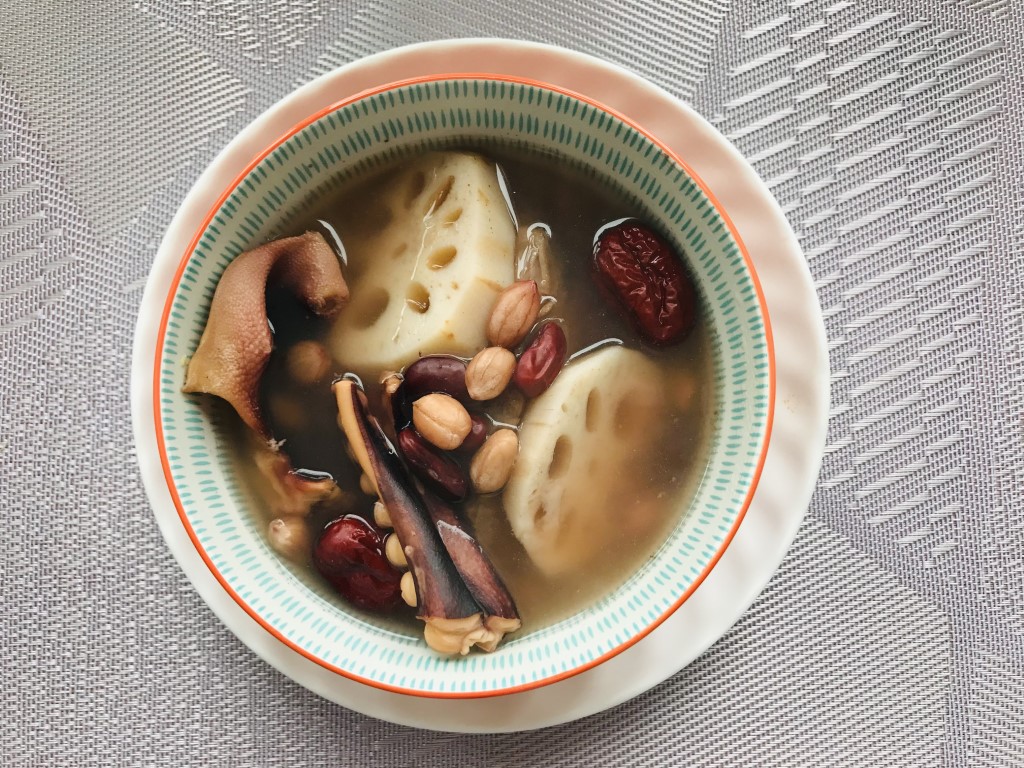
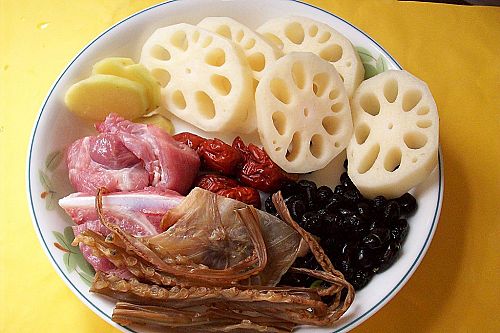
Lotus Root, Black Bean and Dried Octopus Soup
traditionally used to nourish liver blood and support healthy hair
Why people make this soup
Finding grey hairs in your twenties or thirties can feel unsettling, especially when it seems to be happening faster than it should. In traditional Chinese food therapy, premature greying and hair thinning that are not entirely explained by genetics are often linked to insufficient liver blood — the idea being that the blood that nourishes the hair follicles becomes depleted by overwork, poor sleep, chronic worry or emotional exhaustion. This soup brings together three ingredients with a long history of use in that context: lotus root for cooling and nourishing the blood, black soybeans for their association with kidney and liver support (dark-coloured foods have long been connected with hair health in Chinese tradition), and dried octopus for its rich, nourishing quality and mild sweet flavour that makes it a natural base ingredient in blood-building soups.
Who it suits / who should be cautious
- People with premature grey hair, mild hair thinning or dull, lifeless hair associated with a blood-deficient pattern (pale complexion, tiredness, light periods)
- Postpartum women — this soup is traditionally valued for its ability to nourish blood and support milk production
- Suitable for most adults and the whole family
- People with a hot constitution, active skin conditions or inflammatory conditions should avoid this soup
- Soup should not be cooked in iron cookware — lotus root is astringent and can cause the water to turn grey and potentially leach metals; use a clay pot or stainless-steel pot instead
Why these ingredients (the food-therapy logic)
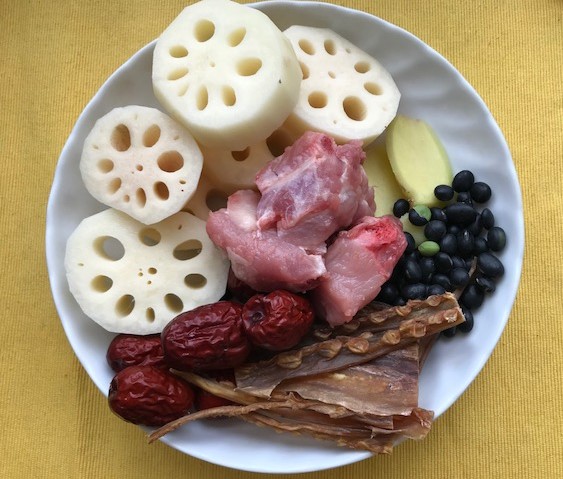
- Lotus root (lian ou): Traditionally considered cooling and blood-nourishing; raw lotus root cools and clears, while cooked lotus root gently builds and replenishes
- Black soybeans (hei dou): In traditional practice, black-coloured foods are associated with the kidney system, which governs hair; black soybeans are also considered to nourish liver blood and are a classic ingredient in hair-support formulas
- Dried octopus (zhang yu): A naturally sweet and nutritious ingredient used in Cantonese cooking to enrich soups; traditionally associated with nourishing blood and qi
- Red dates (hong zao): Support spleen function and blood production; add natural sweetness
- Ginger: Warms the stomach and helps the body process the cooler ingredients
Ingredients (4–5 bowls)
| Ingredient | Amount | Notes |
|---|---|---|
| Fresh lotus root | 600 g | Peeled, cut into chunks; avoid iron cookware |
| Black soybeans | 75 g | Dry-toast in a wok without oil until the skin splits, then rinse |
| Dried octopus | 115 g | Rinse well; soak briefly if very firm |
| Lean pork | 225 g | Blanch in boiling water for 1–2 min, rinse and drain |
| Red dates, pitted | 8 pieces | Pitting releases more flavour and reduces dampness |
| Fresh ginger | 3 slices |
Method
- Dry-toast the black soybeans in a wok over medium heat, without any oil, until the skins begin to split and you can smell a faint nutty aroma. Remove from heat and rinse under cold water.
- Peel the lotus root, cut into chunks.
- Blanch the lean pork in boiling water for 1–2 minutes, then rinse and set aside.
- Rinse the dried octopus and red dates.
- Place all ingredients into a clay pot or large soup pot. Add enough water to cover well (approximately 2 litres / 8 bowls).
- Bring to a boil over high heat, then reduce to a gentle simmer.
- Cook for about 2 hours until the soup is fragrant and the ingredients are tender.
- Season lightly with salt if desired and serve.
Bro Niu’s tips
- The step of toasting the black soybeans is important — it prevents the beans from becoming too cold in nature, which can cause stomach discomfort in some people. This preparation also brings out a richer flavour.
- Do not cook this soup in an iron pot. The astringent quality of lotus root reacts with iron and causes the soup to turn an unpleasant grey colour.
- This soup is also traditionally recommended for women after childbirth — it nourishes blood and is associated with supporting milk production.
- For hair health, consistency matters more than frequency. Drinking this soup 2–3 times a week over several weeks is more effective than occasional large quantities.
Community questions answered (selected)
-
Q (reader, Po yu): I started losing a lot of hair after having my baby two years ago, and I have also noticed quite a few white hairs. Can you suggest something? Bro Niu: Post-birth hair loss often points to qi and blood deficiency. You can alternate between this lotus root soup and a simpler brew of he shou wu (fo-ti root) 5 qian, black soybeans 1 liang, goji berries and mulberry (sang shen zi) 4 qian each — simmer with silkie chicken. You can also look for commercially available he shou wu walnut and black sesame powder at larger supermarkets, which makes a convenient daily drink. Aim for 3 servings per week until you see improvement.
-
Q (Ling): I am 38 and have been experiencing hair thinning and loss for about ten years, worsening recently. What can I do? Bro Niu: Chronic hair thinning can be connected to stress, overwork, or underlying qi and blood deficiency. For external support, you can try applying a tincture of ce bai ye (Platycladus orientalis leaves) soaked in whisky directly to the scalp, once or twice daily — there is minimal odour once dry. Internally, he shou wu walnut and black sesame powder taken daily as a warm drink is a convenient option. Give it consistent use over several months.
-
Q (猫婆婆): I lost a lot of hair after a serious illness years ago. My scalp is oily, I have heavy dampness, and I tend toward heat. Nothing from Western medicine has helped. What food therapy can you suggest? Bro Niu: For your combination of dampness and heat, a gentler approach is better — try a soup of he shou wu 1 liang and huang jing (Polygonatum) 1 liang with lean pork, using 5 bowls of water to make 2 bowls. This nourishes the liver and kidneys and darkens hair without being too warming. Take 3 times per week and give it time to work.
Published March 4, 2010 · Adapted and translated for Nourilo from a traditional home-kitchen recipe. Approx. 5 min read.