Soups
Coral Grass & Goji Berry Sweet Soup
traditionally associated with supporting skin clarity, gentle bowel regularity, and nourishing the liver
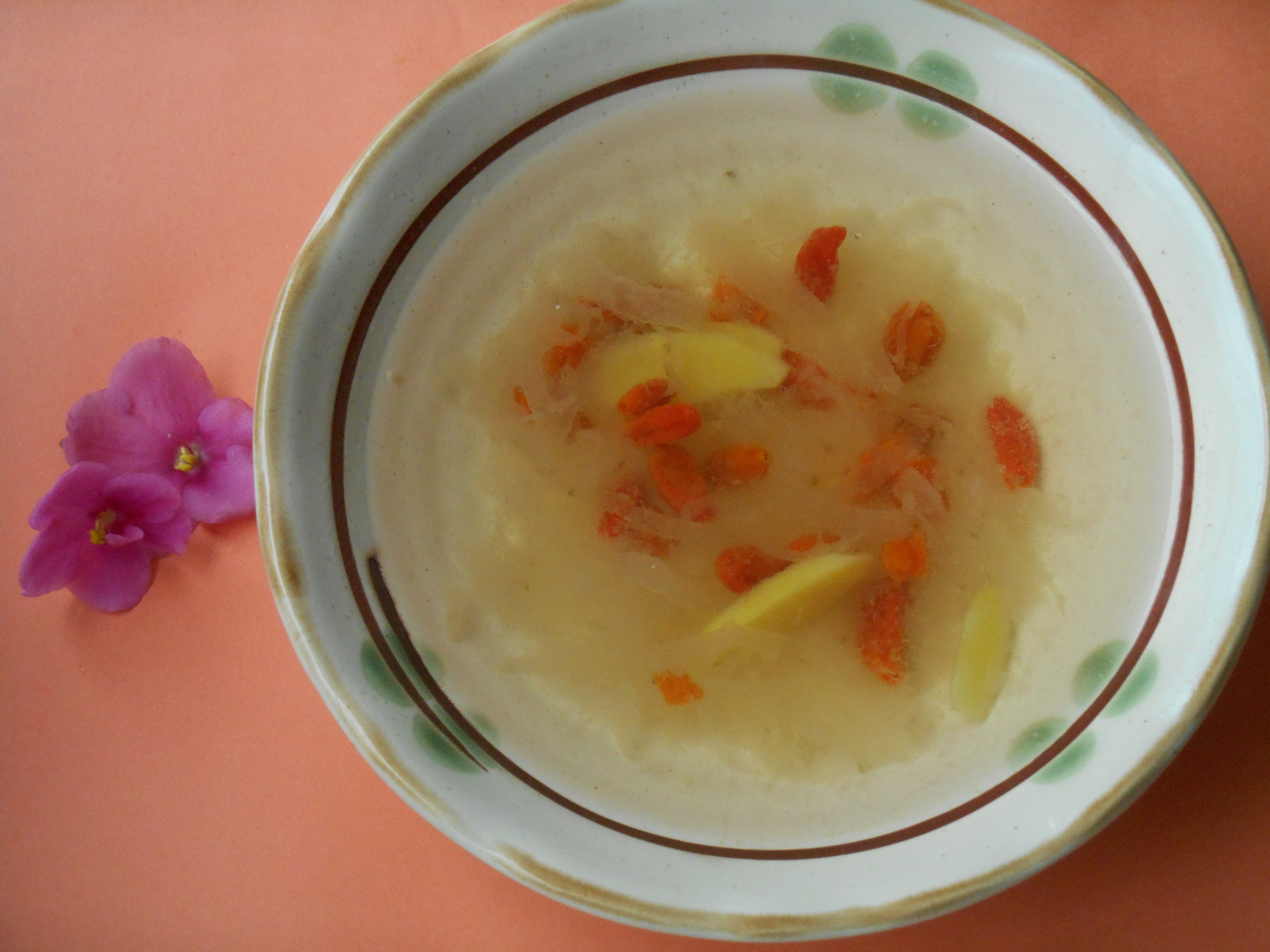
Why people make this sweet soup
Coral grass — called shan hu cao in Cantonese kitchens — is a type of dried red sea algae that expands dramatically when soaked in water, turning from a small tangle of brittle threads into a generous, jelly-like mass. It is exceptionally high in natural plant fibre, contains multiple minerals, and is sometimes compared to a plant-based collagen source. In the tradition of Cantonese sweet soups (tong sui), coral grass has been prized as an ingredient that gently encourages bowel movement, supports skin clarity, and provides a cooling, gelatinous texture that makes a dessert-like sweet soup satisfying without being heavy. Bro Niu particularly recommends it for people who experience frequent constipation, dull or blemished skin, or rough skin texture. Paired with goji berries for their eye and liver associations, and warmed with ginger and brown sugar, this sweet soup is easy to make and pleasant to drink.
Who it suits / who should be cautious
- Suitable for most ages, described by Bro Niu as appropriate for the whole family.
- People with diabetes should substitute the brown sugar with a natural alternative such as stevia or maple syrup.
- Those with thyroid nodules can take this soup — it does not contain large amounts of iodine. However, those with thyroid conditions are generally advised to reduce intake of cruciferous vegetables such as mustard greens, cauliflower, and cabbage.
- People with yin deficiency can also drink this soup without concern.
Why these ingredients (the food-therapy logic)
- Coral grass (shan hu cao): A natural sea algae containing plant fibre, minerals (calcium, iron, magnesium, potassium), and gelatinous compounds. Traditionally regarded as a food that encourages gentle detoxification through the bowel, supports skin clarity, and is associated with delaying skin ageing. Not a high-iodine seaweed.
- Goji berries (gou qi zi): Traditionally paired with coral grass to add liver-nourishing and eye-brightening properties, and to provide a gentle sweetness and colour.
- Ginger (sheng jiang): Warms the stomach to balance the slightly cool nature of the seaweed; also supports healthy digestion.
- Brown sugar (hong tang): Warming in Chinese food tradition, associated with supporting circulation and providing a gentle tonic quality; preferred here over refined white sugar.
Ingredients (2–3 servings)
| Ingredient | Amount | Notes |
|---|---|---|
| Coral grass (shan hu cao) | 1 small handful (~15–20 g dry) | Must be soaked in clean water for a full day before use; change water several times to remove sea smell |
| Goji berries | 1 tablespoon | Rinse and soak briefly |
| Ginger juice | 2 teaspoons | Or use 3–4 fresh ginger slices |
| Brown sugar | to taste | Diabetics: substitute with stevia or maple syrup |
| Water | 4 bowls (~800 mL) |
Method
- Soak the coral grass in clean water for a full day (or overnight), changing the water several times until the sea smell is completely gone. The grass will expand significantly.
- Drain and cut the softened coral grass into shorter pieces with scissors.
- Rinse the goji berries and soak briefly.
- Place the coral grass and goji berries into a pot with 4 bowls of water; bring to a boil.
- Reduce heat and simmer for about 10 minutes.
- Add the brown sugar (or substitute) and stir until dissolved. Serve warm.
Bro Niu’s tips
This sweet soup is gentle enough for the whole family. If you purchase coral grass from Taiwan (sometimes labelled “han tian”), it may already have been partially cleaned and processed — if it softens within 2 hours of soaking, it is likely ready to use without the full overnight soak. As an alternative, some shops sell pre-packaged combinations such as dried red date, longan, coral grass, and brown sugar that you can simply dissolve in hot water as an instant drink. For a variation, Bro Niu also recommends cooking coral grass with longan, red dates, and brown sugar for a blood-nourishing version.
Community questions answered (selected)
-
Q (fire ma jun xing): I have a thyroid nodule (benign, 3.8 cm). Can I eat this sweet soup? Bro Niu: Yes, you can drink the coral grass goji sweet soup without any problem. Those with thyroid nodules should generally avoid mustard greens, cauliflower, and cabbage, as these contain small amounts of substances associated with goitre.
-
Q (coco): Can someone with hyperthyroidism eat coral grass? Bro Niu: Coral grass is a natural organic plant that grows in wetlands or by the sea — it contains large amounts of plant-based gelatin, calcium, iron, magnesium, and potassium, but it is not high in iodine. Those with hyperthyroidism can eat it.
-
Q (yan): Is this soup suitable for someone with yin deficiency? Bro Niu: Yes, people with yin deficiency can drink this soup.
Published May 12, 2014 · Adapted and translated for Nourilo from a traditional home-kitchen recipe. Approx. 4 min read.