Soups
Green Papaya, Red-Skin Peanut and Fish Soup
Traditionally associated with nourishing blood, smoothing skin and supporting post-natal recovery
Why people make this soup
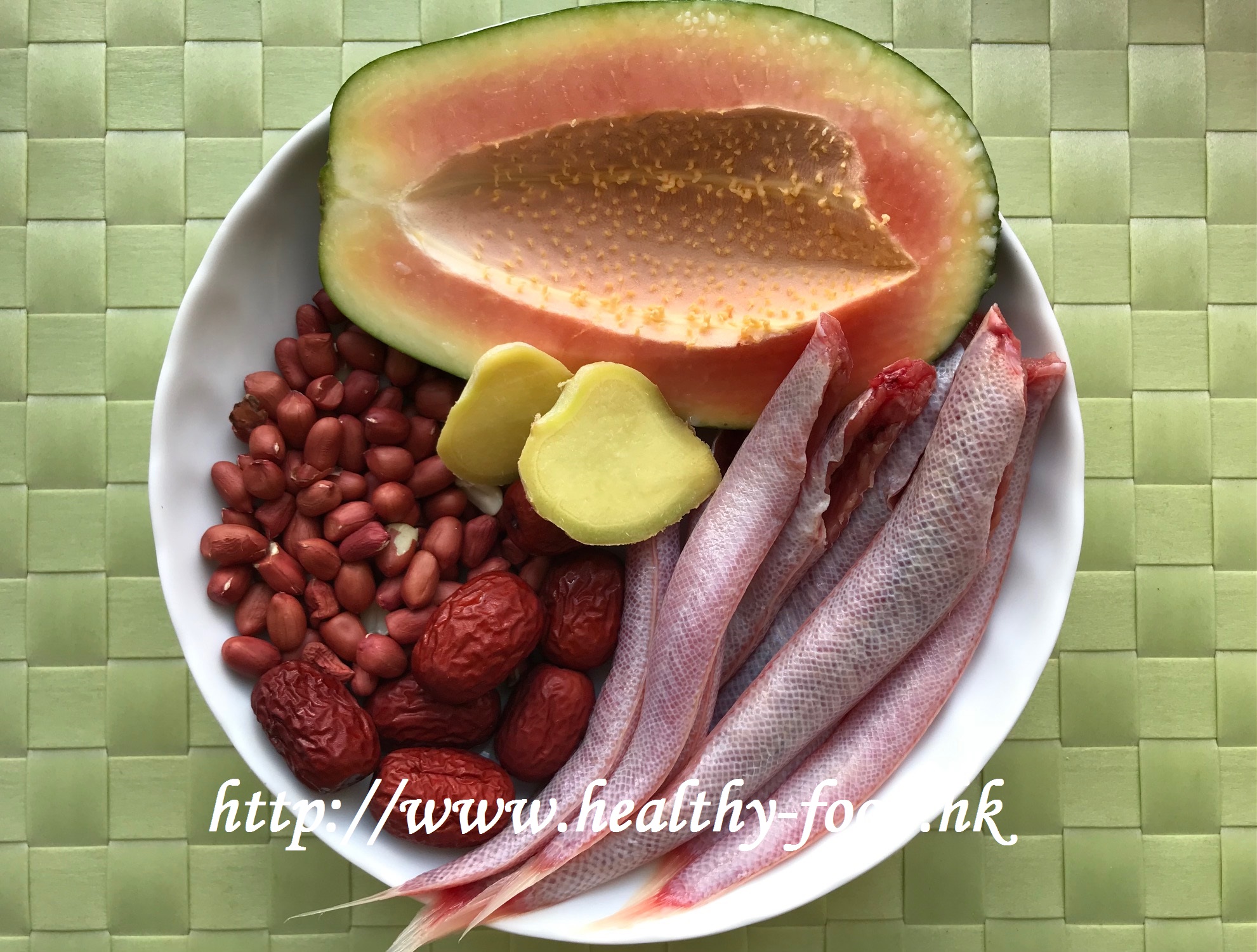
Red fish (hong shan or hong zhan) are slim, small, bright-red freshwater fish that occasionally appear at wet-market fish stalls. They are somewhat difficult to prepare because of their small size and fine texture, so most home cooks use them primarily for soup. Despite the modest appearance, their nutritional value is impressive — rich in minerals, protein and vitamins — and they are particularly well-suited to pregnant women, those who have recently given birth, and breastfeeding mothers. Green (unripe) papaya paired with red-skin peanuts and red dates creates a soup with a naturally rosy colour and a gently sweet, clean flavour. Together, these ingredients are traditionally associated with smoothing and brightening the skin, supporting blood quality, strengthening digestion and encouraging breastmilk production.
Who it suits / who should be cautious
- Particularly well-suited to women who are pregnant, newly post-partum or breastfeeding, as both red fish and green papaya are traditionally considered supportive of these life stages.
- Also suitable for those who are anaemic, have a dull or uneven complexion, or wish to support skin health through diet.
- People with gout can enjoy a small amount of broth; avoid eating large quantities of the fish, as fish and seafood contain purines.
Why these ingredients (the food-therapy logic)
- Green papaya (qing mu gua): Unripe papaya contains papain and is traditionally associated with supporting digestion, smoothing the skin and encouraging breastmilk production. It also has a place in traditional anti-cancer food therapy.
- Red-skin peanuts (hong yi hua sheng): The red skin of the peanut is the most important part for blood-nourishing purposes — it is traditionally associated with improving platelet quality and helping to address anaemia. Always cook with the skin on.
- Red dates (hong zao): A classic blood and qi tonic; add sweetness and warmth to the broth.
- Red fish (hong shan): Rich in protein and minerals; traditionally considered to strengthen the spleen and support blood — a gentle, nourishing protein well-suited to post-partum and pregnancy needs.
Ingredients (4 bowls)
| Ingredient | Amount | Notes |
|---|---|---|
| Green (unripe) papaya | 1 medium | Peeled, seeded and cut into chunks |
| Red-skin peanuts | 60 g (2 liang) | Rinsed; keep the red skin on |
| Red dates | 6 | Pitted |
| Fresh ginger | 3 slices | |
| Red fish | ~600 g (1 jin) | Trim off head and belly with a diagonal cut, rinse, dry and pan-fry |
| Water | 7 bowls (~1.75 L) |
Method
- Peel and seed the green papaya; cut into chunks. Rinse the red-skin peanuts (keep skins on). Pit the red dates.
- Cut the head and belly off the red fish at a diagonal, rinse and pat dry. Heat a little oil in a pan and pan-fry the fish until golden.
- Place all ingredients — including the pan-fried fish — into a pot with 7 bowls of water.
- Bring to a boil, then simmer steadily for 1 hour until the soup has reduced to about 4 bowls.
- Serve the soup and solid ingredients together and enjoy.
Bro Niu’s tips
The red skin of the peanut is the most important component for blood-supporting purposes — removing it before cooking wastes the very part that makes this soup effective. Green (unripe) papaya, rather than ripe yellow papaya, is used here because it contains more of the enzymes traditionally associated with digestion support and breastmilk production. If red fish is not available at your local market, ask for it by name — it is worth seeking out. If unavailable, another small freshwater fish can be substituted.
Community questions answered (selected)
-
Q (Elaine): I have poor qi and blood but whenever I take a rich tonic I get inflamed gums. What can I do? Bro Niu: Try the three-date stir-fried rice tea (san zao chao mi cha) — all three types of dates combined with toasted rice, which you can drink every day. Mulberry and lotus seed with red dates water (sang ji sheng lian zi hong zao shui) can be taken 2 times a week. If heat arises, brew some American ginseng and chrysanthemum tea to cool it down.
-
Q (Cathy Ho): A friend gave me a recipe using fish maw, pork shank, chicken breast, astragalus, codonopsis, red dates, honey dates and ginger. What is it good for? Bro Niu: This combination tonifies qi and blood. It is particularly helpful after surgery for wound healing, and also suits those with qi and blood deficiency generally. Wait until you have a good appetite before eating the fish maw — it can be heavy on the stomach if you are still weak.
Published September 21, 2020 · Adapted and translated for Nourilo from a traditional home-kitchen recipe. Approx. 4 min read.