Soups
Mulberry, Goji Berry and Quail Soup
traditionally nourishes the liver and kidneys to support vision, reduce blurriness, and ease dizziness and tinnitus
Why people make this soup
It is a familiar modern problem: children with faces pressed to screens, teenagers developing near-sightedness, adults ending the day with tired, strained eyes. Traditional Chinese food therapy has long associated the health of the eyes with the liver and kidney meridians — so the approach is to nourish those organs rather than treat the eyes directly. Red, yellow, and deep purple-black fruits and vegetables are considered especially supportive of the visual nerves, which is why mulberries, goji berries, carrots, tomatoes, blueberries, and strawberries all feature prominently in eye-health cooking. This soup uses mulberries and goji berries as its core, paired with quail — sometimes called the “ginseng of animals” for its remarkably tonifying effect on the five organs — and red dates. The result is a clear, subtly sweet broth that is gentle enough for children and nourishing enough for the elderly.
Who it suits / who should be cautious
- Children with early near-sightedness, astigmatism, or blurry vision from screen time.
- Adults experiencing eye fatigue, lower back soreness, mild dizziness, or tinnitus — symptoms that traditional Chinese food therapy links to liver-kidney deficiency.
- Suitable for the elderly and children alike.
- Can be stored in the refrigerator and divided over two days (4 bowls total).
Why these ingredients (the food-therapy logic)
- Mulberries (sang shen): A deep purple-black fruit traditionally associated with nourishing liver blood and kidney essence, which in turn supports healthy vision. Rich in anthocyanins, which Western nutrition research links to vascular health in the retina.
- Goji berries (gou qi zi): The most widely used food-therapy ingredient for eye health in Chinese tradition; nourishes liver blood and kidney yin, which are considered the foundation of healthy vision.
- Quail (chun): Described in traditional medicine as tonifying the five organs; richer in nutrients per gram than chicken; its broth is clean, sweet, and nourishing.
- Red dates (hong zao): Support blood production and harmonise the other ingredients.
Ingredients (4 bowls — serves 2 days)
| Ingredient | Amount | Notes |
|---|---|---|
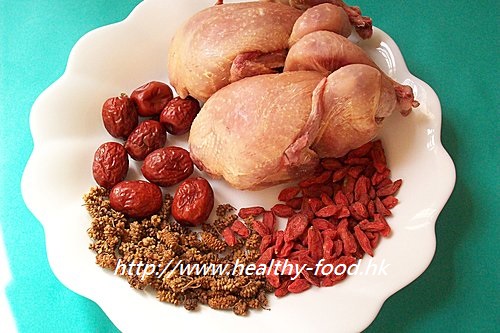
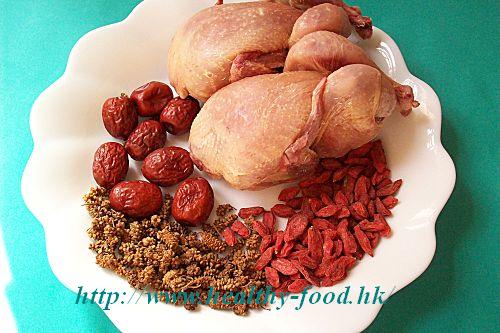
| Mulberries (dried) | 19 g | Or use 75 g fresh if in season |
| Goji berries | 19 g | Rinsed |
| Red dates | 8 pieces | Pitted |
| Frozen quail | 2 birds | Defrosted |
| Water | 8 bowls (~2 litres) |
Method
- Defrost the quail completely. Bring a pot of water to a boil and blanch the quail briefly to remove impurities; drain and rinse.
- Rinse the mulberries, goji berries, and red dates. Pit the dates.
- Place all the ingredients in a soup pot with 8 bowls of water.
- Bring to a boil, then reduce to a gentle simmer and cook for about 2 hours until the liquid reduces to approximately 4 bowls.
- Season with salt and serve. Refrigerate leftovers and reheat the next day.
Bro Niu’s tips
Fresh mulberries are only in season for a short window each year — when available, use the fresh ones for the best flavour and colour. At other times, dried mulberries work well. Quail is considered the “ginseng of animals” in traditional food therapy for its ability to tonify all five major organs. If you cannot find quail, silkie chicken or lean pork are good substitutes. Frozen quail is available at large supermarkets, frozen food stores, and online Asian grocers.
Community questions answered (selected)
-
Q (reader, mschanchan): Can I use fresh quail? Is it widely available? Bro Niu: Fresh quail can be difficult to find; frozen quail (imported) is available at large supermarkets and frozen food shops. If unavailable, substitute with silkie chicken or partridge (zhe gu).
-
Q (reader, zhan140 — child with severe hyperopia and amblyopia): My 6-year-old has 725/750 degrees hyperopia with astigmatism and 0.3 vision. Are there any tonic soups that might help alongside his treatment? Bro Niu: Try jin chan hua (4 qian), goji berries (4 qian), rui ren rou (3 qian), one carrot, and a small piece each of pig liver and lean pork, in 8 bowls of water cooked down to 4. Divide over 2 days; take 2 times per week. This soup can support eye health over time, but it requires patient, regular use. Jin chan hua (cicada flower mushroom) is a remarkable ingredient whose genetic profile has been shown to be very close to cordyceps — buy from a reputable source.
-
Q (reader): Can the 4 bowls of soup be refrigerated and drunk over two days? Bro Niu: Yes — store the remaining soup in the refrigerator and reheat the next day.
Published March 6, 2010 · Adapted and translated for Nourilo from a traditional home-kitchen recipe. Approx. 4 min read.