Soups
Morinda, Euryale, Achyranthes and Pork Bone Soup
traditionally used to nourish liver and kidney, support lower-back strength, and ease joint stiffness
Why people make this soup
Many older adults notice that their lower back and knees feel noticeably worse during cold or damp weather — that aching stiffness that makes turning over in bed or climbing stairs a real effort. In traditional Chinese food-therapy, this pattern is associated with a gradual decline of kidney qi (vital energy), which is thought to govern bone strength and fluid regulation. Cold and damp conditions are believed to penetrate more easily when kidney qi is low, settling in the lumbar region and joints and disrupting normal circulation. This hearty soup pairs morinda root and achyranthes root — two herbs with a long history in Chinese herbalism for supporting the lower back and joints — with euryale seeds, cashews, and figs for nourishment. Slow-cooked pork bones add collagen and a rich, comforting broth.
Who it suits / who should be cautious
- Middle-aged and older adults with chronic lower-back ache or knee weakness, especially worse in cold and damp weather
- Suitable for the whole family as a general strengthening soup; eat some of the solids, not just the broth
- Pregnant women must avoid this soup because achyranthes root (niu xi) has a traditional action of promoting downward movement and is considered contraindicated in pregnancy
- Not suitable when you have a cold or flu; wait until the illness has fully resolved before taking any tonifying soup
Why these ingredients (the food-therapy logic)
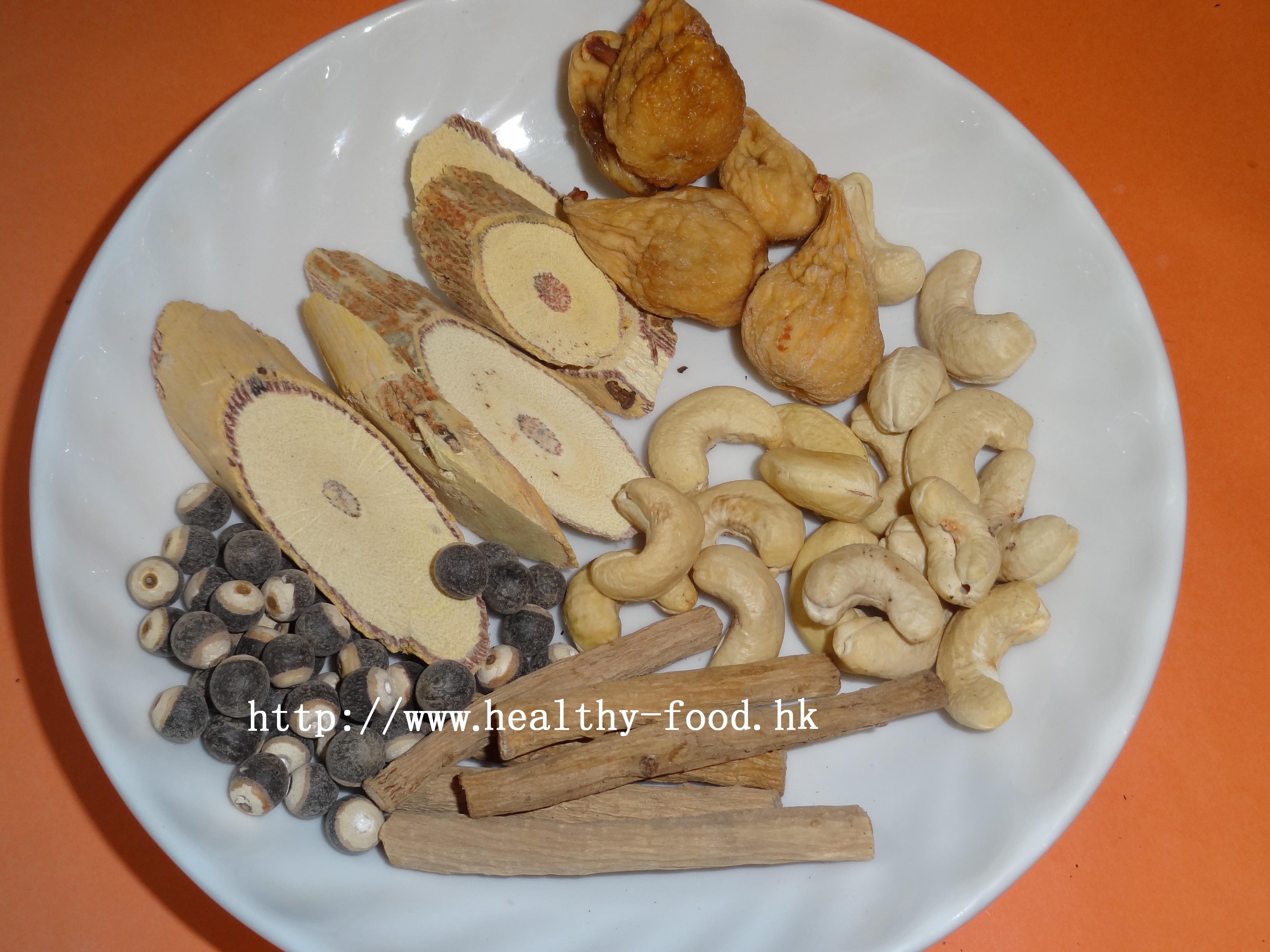
- Morinda root (niu da li): A sweet, warming herb traditionally associated with tonifying the liver and kidney, and supporting ligament and bone strength; widely used in Cantonese cooking
- Euryale seeds (qian shi): Considered to tonify the spleen and kidney, and to help consolidate essence; often paired with other kidney-support herbs
- Cashew nuts (yao guo): In food-therapy, nuts are broadly viewed as kidney-nourishing; cashews add a mild, creamy richness to the broth
- Achyranthes root (huai niu xi): A key herb in this formula — traditionally said to strengthen sinews and bones, improve circulation in the lower limbs, and act as a “guiding herb” that directs the action of other herbs downward toward the lower body; also associated with lowering blood viscosity and supporting healthy circulation
- Dried figs (wu hua guo): Add natural sweetness and are traditionally seen as gently nourishing
Ingredients (3–4 bowls)
| Ingredient | Amount | Notes |
|---|---|---|
| Morinda root (niu da li) | 38 g dried / 75 g fresh | Soak and rinse before use |
| Euryale seeds (qian shi) | ~38 g (1 liang) | Soak and rinse |
| Cashew nuts (yao guo) | ~38 g (1 liang) | Rinse |
| Achyranthes root (huai niu xi) | ~11 g (3 qian) | Rinse; see caution above for pregnant women |
| Dried figs (wu hua guo) | 4 pieces | Rinse |
| Pork bones | ~300 g (8 liang) | Blanch in boiling water first to remove impurities |
| Water | 8 bowls (~1.9 L) | Reduce to 3–4 bowls |
Method
- Blanch the pork bones in boiling water for 2–3 minutes, then drain and rinse off any grey foam.
- Soak and rinse morinda root, euryale seeds, and achyranthes root; rinse figs and cashews.
- Place all ingredients into a pot with 8 bowls of water.
- Bring to a boil, then reduce to a low simmer and cook for 3 hours, until the liquid reduces to about 3–4 bowls.
- Serve warm. Eat some of the pork and solids along with the broth.
Bro Niu’s tips
The achyranthes root pictured in the original article is huai niu xi — the type that prioritises joint support and bone-strengthening — rather than chuan niu xi, which leans more toward blood-moving. If your herb shop only has chuan niu xi, it still works, just with a slightly different emphasis. If you cannot find morinda root at all, du zhong (eucommia bark, ~20 g) makes a reasonable substitute for this purpose. For those who prefer to avoid pork, lean pork shoulder or shank works just as well as pork bones. This soup can be double-cooked (炖) for 3 hours as an alternative method.
Community questions answered (selected)
-
Q (Kathy): I have a herniated disc with leg numbness — will this soup help? Bro Niu: A herniated disc is difficult to address with food-therapy alone; you should see a physiotherapist or a TCM bone-injury specialist. As everyday support, eating foods like chestnuts, euryale seeds, cashews, walnuts, and black soybeans — which are all traditionally kidney-nourishing — can be a useful complement to treatment.
-
Q (reader): My mother is 68, has three highs (blood pressure, blood sugar, cholesterol) and bone loss, and now has severe lower back pain. Can she have this soup? Bro Niu: Your mother can drink this soup, but since figs are higher in natural sugars, use only 2 pieces instead of 4. A gentler everyday option for her would be eucommia bark (1 liang), mulberry mistletoe (5 qian), and black soybeans (1 liang) simmered with pork bones for an hour and a half — this supports liver and kidney, strengthens bone, and clears damp-cold. Take it 2 hours after her Western medications.
-
Q (reader, after cold/flu): My wife has just had a miscarriage and has headaches and lower back pain. What soup is appropriate? Bro Niu: She can use eucommia bark (5 qian), black soybeans (1 liang), longan flesh (10 pieces), and pork kidney or lean pork — this nourishes the liver and kidney and supports the lower back. For headaches, a soup with ligusticum (chuan xiong, 2 qian), angelica root (bai zhi), and polygonatum (huang jing) each 3 qian, with fresh ginger, simmered with fish head or lean pork, can help.
Published March 1, 2012 · Adapted and translated for Nourilo from a traditional home-kitchen recipe. Approx. 4 min read.