Soups
Lotus Root, Goji Berry, and Geoduck Clam Soup
Traditionally used to nourish the liver and kidney, strengthen the lower back and bones, and support spinal health

Why people make this soup
Lower back pain is something many people accept as an unavoidable part of ageing — but Bro Niu always says it is worth paying attention to early. In younger and middle-aged adults, waking up with a stiff, uncomfortable lower back that gradually eases with movement is a pattern worth noting: it can be an early sign of changes to the intervertebral discs or the ligaments and joint capsules around the lumbar spine. Left unaddressed, these changes may progress toward hypertrophic spondylitis or sciatic nerve compression. From the inside, supporting bone and joint health through diet is genuinely helpful. Foods rich in calcium, phosphorus, protein, and vitamins — including legumes and tofu, sea fish, shellfish, shrimp, egg yolk, and dairy — are all particularly relevant. This soup brings together lotus root for its high calcium content and spleen-strengthening properties, with goji berries for liver-kidney nourishment, and geoduck clam — one of the most protein-rich shellfish available — for its traditional association with tonifying the kidneys and strengthening the lower back. The result is a fresh, naturally sweet soup that the whole family can enjoy regularly.
Who it suits / who should be cautious
- Suitable for adults and elderly experiencing lower back discomfort or lumbar degeneration. Also beneficial for younger adults as a preventive support.
- The soup is mild and suitable for the whole family including children.
- Those with known shellfish allergies should avoid geoduck clam. The clam can be omitted and the soup still provides benefit from the lotus root and goji berries.
- Avoid smoking and alcohol, and limit citrus fruits (which in some traditional references are considered to interfere with calcium and phosphorus absorption in spinal conditions).
Why these ingredients (the food-therapy logic)
- Lotus root (lian ou): Rich in calcium and easy to cook. In traditional Chinese food therapy it is associated with strengthening the spleen and stomach, nourishing blood, and cooling without being excessively cold. An excellent everyday soup vegetable.
- Goji berries (gou qi zi): Nourish liver and kidney yin. In Chinese medicine, the kidneys are considered to govern the bones, so kidney nourishment directly supports bone and spinal health.
- Carrot: Adds beta-carotene and natural sweetness; also associated with supporting the liver in traditional food therapy.
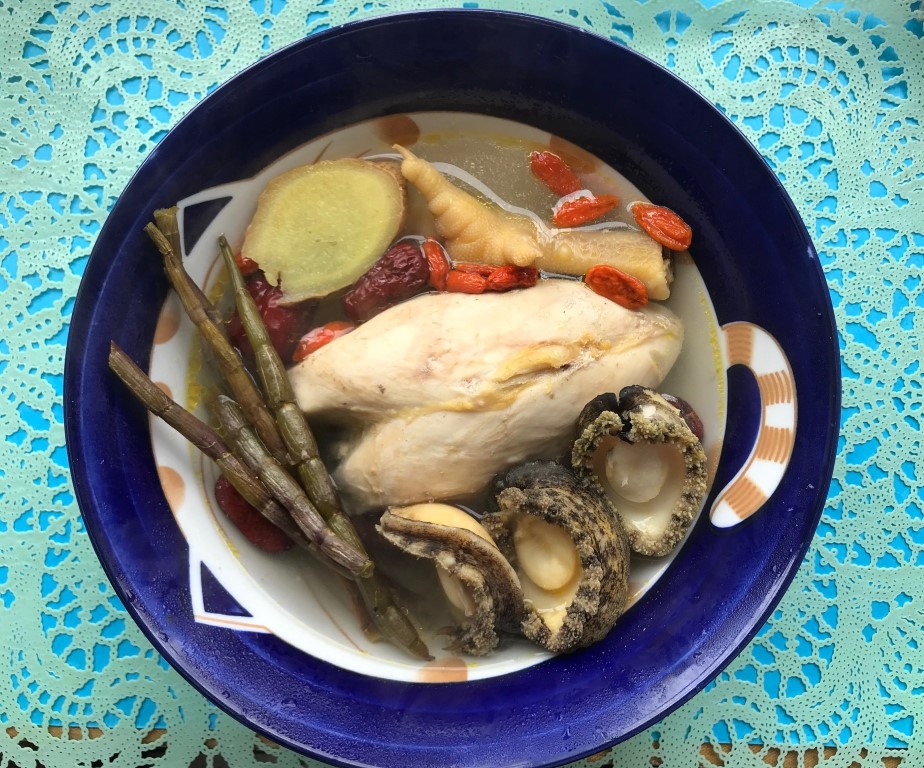
- Geoduck clam (xiang ba bang): A large, protein-rich bivalve clam traditionally associated with tonifying kidney deficiency and strengthening the lower back and bones. Fresh geoduck should be added only at the end of cooking to prevent toughening. Dried geoduck can be simmered with the other ingredients for 2 hours for an equally rich, flavourful result.
Ingredients (4 bowls)
| Ingredient | Amount | Notes |
|---|---|---|
| Lotus root (lian ou) | 600 g (~1 jin) | Peel and cut into chunks |
| Goji berries (gou qi zi) | 3 qian (~11 g) | Rinse briefly |
| Carrot (hong luo bo) | 1 medium | Peel and cut into chunks |
| Fresh ginger | 3 slices | — |
| Geoduck clam (xiang ba bang) | 300 g (~half jin) | Remove shell; rinse well |
| Water | 8 bowls (approx. 2 litres) | — |
Method
- Peel the lotus root and carrot and cut into large chunks. Rinse the goji berries.
- If using fresh geoduck: remove the shell and clean the meat thoroughly; set aside to add later.
- Place all ingredients except the geoduck into a pot with 8 bowls of water.
- Bring to a boil, then reduce to a gentle simmer.
- Cook for about 1.5 hours (90 minutes), until the lotus root is tender and the broth is flavourful.
- Add the fresh geoduck clam meat and simmer for a further 5 minutes, until just cooked through — do not overcook or the clam will become tough.
- Serve immediately and eat the soup and solid ingredients together.
Note: If using dried geoduck, add it with all the other ingredients at the start and simmer for 2 hours. The dried version makes the broth even richer and more flavourful.
Bro Niu’s tips
This soup has a naturally fresh, sweet flavour from the lotus root and carrot — it is genuinely delicious and not at all heavy or medicinal tasting. The key with fresh geoduck is timing: add it only in the last five minutes of cooking, just until the clam turns opaque and is just cooked through. If you cannot find fresh geoduck, frozen clam is perfectly fine. The dried version is also wonderful — simply add it at the very beginning and let it simmer alongside all the other ingredients for the full 2 hours. If you are interested in general spinal health, it is also worth reducing smoking and alcohol, and maintaining gentle regular exercise.
Community questions answered (selected)
-
Q (Joey): Can frozen geoduck be used in this soup? Bro Niu: Yes, frozen geoduck works perfectly well.
-
Q (Nat): My husband has recurring lower back muscle inflammation — three times in the past year. An MRI showed no disc herniation but mild degeneration at one level. Is there a soup that would help? Bro Niu: Try: ba ji (morinda root) and du zhong (eucommia bark) 5 qian each, chuan niu xi (Sichuan achyranthes) 3 qian, black beans 1 liang, south jujube 5 pieces — simmer in a pork tendon soup. Drink three times a week for two weeks first and see how it helps. This combination traditionally supports liver and kidney, strengthens sinews and bones, and eases lower back pain.
-
Q (Fi Fi): My mother is in her 70s and over the past two weeks her legs have been very weak. She used to swim every day but now finds even lifting her legs tiring. What soup is appropriate? Bro Niu: For an elderly person with weak legs and some bloating, try: ba ji (morinda root) 5 qian, chestnuts 3 liang, Chinese yam 1 liang, euryale seeds (qian shi) 1 liang, chen pi (tangerine peel) 1 piece — simmer in a pork tendon soup for 2–3 days. This combination strengthens the spleen and kidney and supports leg strength in the elderly.
Published December 29, 2020 · Adapted and translated for Nourilo from a traditional home-kitchen recipe. Approx. 5 min read.