Congee & Porridge
Water Chestnut and Job's Tears Congee
traditionally used to clear heat, support the spleen, ease dampness, and help reduce uric acid levels
Why people make this congee
Gout is one of those conditions that runs in families — if a parent or grandparent had it, the risk increases. It is also strongly influenced by diet: foods rich in purines (organ meats, shellfish, certain mushrooms, legumes, and alcohol) can elevate uric acid levels and trigger attacks. For people managing gout — or trying to prevent a first episode — food choices matter day to day.
Water chestnuts and Job’s tears are both low-purine foods, and both play important roles in traditional Chinese food therapy for conditions characterised by dampness and heat in the joints. This simple congee is something Bro Niu recommends for regular consumption rather than a one-time remedy — the idea is to build a habit of low-purine, dampness-clearing eating. Taken morning and evening as part of a balanced diet, it can form a useful part of a gout-management routine.
Drink plenty of water every day alongside this congee — adequate hydration is one of the most well-supported strategies for promoting uric acid excretion.
Who it suits / who should be cautious
- Suitable for people managing gout or elevated uric acid, and those with a family history of gout.
- Job’s tears and water chestnuts are both mildly cooling; people with a cold constitution, spleen-kidney deficiency, or chronic digestive weakness should use caution and may wish to reduce the frequency or add warming ingredients.
- Pregnant women should avoid Job’s tears, which is traditionally contraindicated in pregnancy.
- For general wellness: this is a light, low-fat congee with an anti-fatigue association in Chinese food therapy and can be enjoyed by most people occasionally.
Why these ingredients (the food-therapy logic)
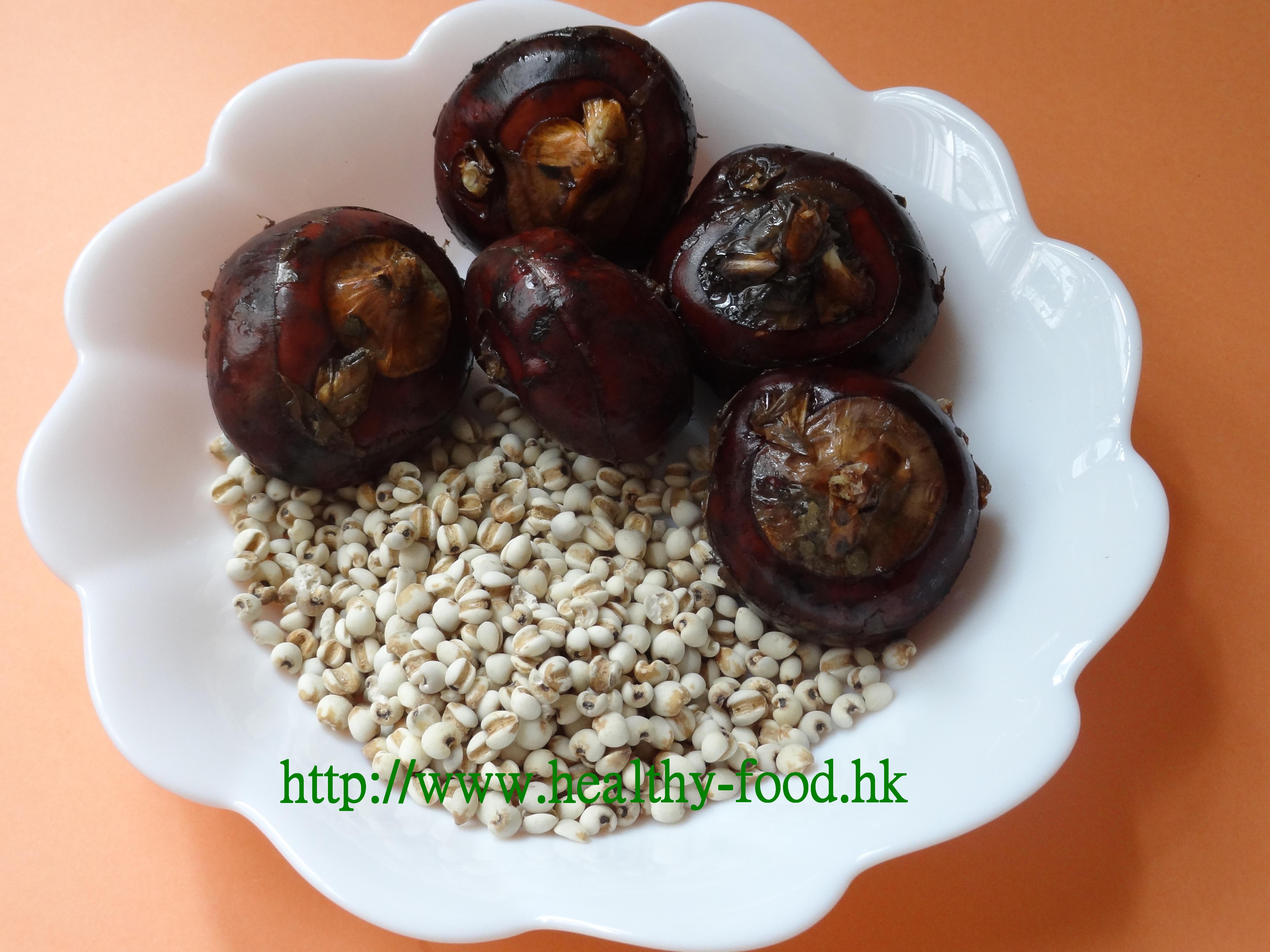
- Raw Job’s tears (sheng yi mi): One of the most versatile grains in Chinese food therapy, associated with supporting the spleen, clearing dampness, clearing heat, and promoting healthy fluid metabolism. The raw (unroasted) form is preferred for its cooling, dampness-clearing properties.
- Water chestnut (ma ti): A crunchy aquatic vegetable used extensively in Chinese cooking. Low in purines and traditionally associated with clearing heat, detoxification, promoting healthy circulation, and easing joint discomfort associated with heat and dampness.
- Honey (feng mi): Added at the end as a gentle sweetener. Honey is traditionally considered mild and nourishing in Chinese food therapy, and is a preferable sweetener to refined sugar for everyday wellness recipes.
Ingredients (3–4 bowls)
| Ingredient | Amount | Notes |
|---|---|---|
| Raw Job’s tears (sheng yi mi) | 113 g (3 oz) | Rinsed |
| Water chestnuts (ma ti) | 5–6 pieces | Peeled and cut into chunks |
| Honey | A small drizzle | Stirred in at the end, off heat |
Method
- Rinse the Job’s tears thoroughly. No soaking required but soaking for 30 minutes speeds up cooking.
- Peel and roughly chop the water chestnuts.
- Combine Job’s tears, water chestnuts, and 6 bowls (about 1.5 litres) of water in a pot.
- Bring to a boil, then reduce to a low simmer. Cook for 1 hour, stirring occasionally, until the Job’s tears have softened and the mixture has thickened to a porridge-like consistency.
- Remove from heat. Stir in a drizzle of honey to taste.
- Serve in the morning and again in the evening as part of regular meals.
Bro Niu’s tips
Use raw Job’s tears (sheng yi mi), not the roasted variety, for this recipe. Raw Job’s tears are more cooling and better suited to the damp-heat clearing purpose of this congee. The congee has a mild anti-fatigue quality as well, which is a welcome bonus for those managing gout who may feel tired during flare-up periods.
Important reminder: if you have gout, keep your distance from high-purine foods: organ meats, shellfish and molluscs, certain mushrooms (especially shiitake), most legumes (though adzuki beans are considered an exception due to their diuretic properties and very low purine content), and alcohol — especially beer.
Community questions answered (selected)
-
Q (amony): Which type of Job’s tears should I use for this congee? Bro Niu: Use raw Job’s tears (sheng yi mi) — the unroasted kind. That is the correct choice for this recipe.
-
Q (anne): Can canned water chestnuts and Job’s tears be used? Bro Niu: Canned is of course not as good as fresh, but if you are short on time, it is fine occasionally. Use whenever convenient.
-
Q (苏太): Is eating cherries good for lowering uric acid? Bro Niu: Yes — cherries can help inhibit uric acid production, and they are in season right now so it is a great time to eat more. You can also soak cherries in rice wine to preserve them for use after the season ends.
Published August 19, 2013 · Adapted and translated for Nourilo from a traditional home-kitchen recipe. Approx. 4 min read.