Herbal & Flower Teas
Rose Jasmine Bergamot Tea
Traditionally supports liver qi flow and soothes the stomach
Why people make this tea
When stress builds up and digestion starts feeling sluggish — that tight, bloated feeling after meals, or a faint bitter taste in the mouth — traditional Chinese food therapy often turns to aromatic flowers that are thought to help the liver “release” held tension. This simple three-ingredient tea combines rosebuds, jasmine, and dried bergamot strips, all of which have long been used to calm the stomach and ease that wound-up feeling. It is a pleasant everyday brew rather than a strong medicinal formula.
Bergamot (fo shou gan) can be a little hard to find, but most Asian herb shops stock it dried and pre-shredded. The slightly bitter edge it brings is balanced nicely by the sweetness of rose and jasmine.
Who it suits / who should be cautious
- Suited to adults and children who feel stressed, easily irritated, bloated after meals, or experience mild nausea
- Also useful after overeating or for general digestive discomfort
- Pregnant women should not drink floral teas
- Those with a very cold constitution may add a small slice of dried tangerine peel to warm the blend
Why these ingredients (the food-therapy logic)
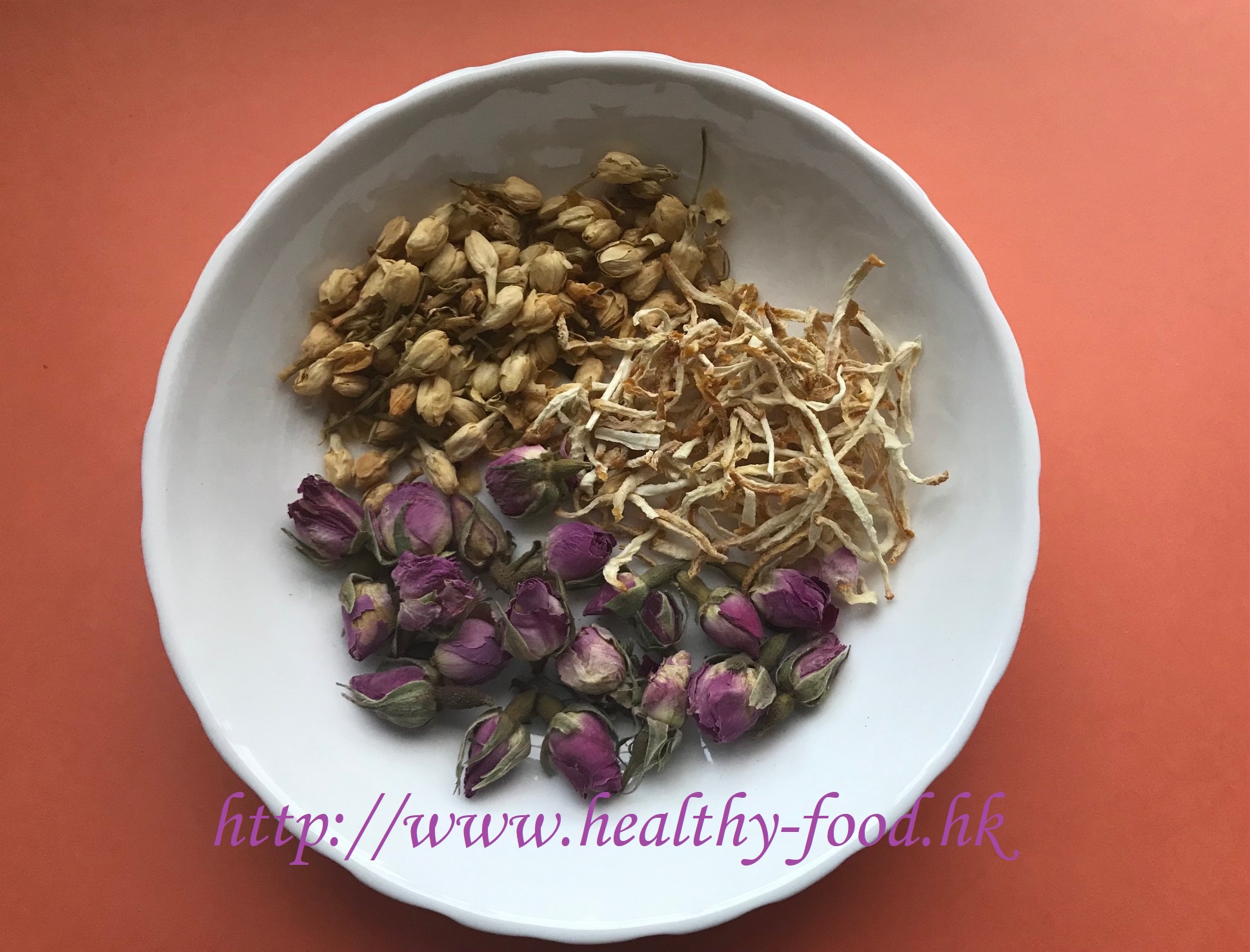
- Rosebuds (mei gui hua): Long used in Chinese food therapy to smooth liver qi and ease emotional tension; the mild fragrance is thought to gently lift the spirit
- Jasmine flowers (mo li hua): Traditionally associated with calming the nervous system and easing stomach irritation; a popular everyday flower for digestive comfort
- Bergamot strips (fo shou gan si): Enters the liver and stomach meridians; traditionally used to support digestion, relieve mild nausea, and warm a cold stomach
Ingredients (1 pot / 1–2 cups)
| Ingredient | Amount | Notes |
|---|---|---|
| Dried rosebuds | 1 tablespoon | Any good-quality dried rose blossom |
| Jasmine flowers | 1 tablespoon | Dried; separate from jasmine green tea blend |
| Dried bergamot strips (fo shou gan si) | 1 tablespoon | Available from Chinese herb shops; alternatively buy whole dried bergamot and snip it yourself |
| Raw honey | To taste | Optional; add after steeping |
Method
- Place all three ingredients in a teapot or heatproof cup.
- Pour a little boiling water over the herbs, swirl briefly, and discard the rinse water.
- Add fresh boiling water to fill the pot, then cover and steep for 10 minutes.
- Pour into cups. Stir in a little raw honey if desired.
- The same herbs can be re-steeped with fresh hot water until the flavour fades.
Bro Niu’s tips
This tea has a mild bitter note from the bergamot — a touch of honey rounds it out nicely. If you cannot find bergamot strips at a grocery store, look in any traditional Chinese herb shop where it can be sold whole; simply cut it into smaller pieces before steeping. The tea is suitable for the whole family, but pregnant women should skip floral teas altogether.
Community questions answered (selected)
-
Q (yan): Bro Niu, for liver qi stagnation what soup could I make? Bro Niu: You could try a soup with day lily (jin zhen), snow fungus (xue er), lily bulbs (bai he), and one apple (cored), simmered with lean pork. Eat the solids too — they help move stagnant qi. This flower tea is also a good daily habit alongside any soup.
-
Q (yan): What soup is good for liver-stomach disharmony gastritis? Bro Niu: This flower tea itself is helpful. You could also cook a soup with three monkey head mushrooms (hou tou gu), five-finger fig root (wu zhi mao tao, about 5 qian), four red dates, and one piece of tangerine peel with pork shin — this combination is good for gastritis.
-
Q (YY): My mother just had acute gastroenteritis. She has stopped vomiting after two days of medication and is now on plain congee. What soup water would suit her? Bro Niu: Try a soup with Chinese yam (huai shan), fried hyacinth beans (chao bian dou), and foxnut (qian shi) — about 1 liang each — plus one piece of tangerine peel and four red dates, simmered with lean pork. This strengthens the spleen and firms the stool. The whole family can drink it.
Published February 9, 2021 · Adapted and translated for Nourilo from a traditional home-kitchen recipe. Approx. 3 min read.