Herbal & Flower Teas
Poria Cocos, Job's Tears, and Fresh Ginger Tea
Traditionally associated with clearing bad breath, relieving bloating, and draining excess dampness
Why people make this tea
Bad breath is something many people quietly worry about, especially in social situations. Bro Niu points out that it rarely has a single cause. In traditional Chinese wellness, persistent bad breath is often linked to internal imbalances such as excess heat in the stomach and intestines, a congested spleen with accumulated dampness, or even liver heat. Of course it can also come from dental issues like cavities or gum disease — those need dental care, not food therapy. But when the cause is more of a digestive-damp origin — bloating, sluggish digestion, a tendency toward weight gain and water retention — this three-ingredient tea has been used for generations as a gentle daily tonic.
Who it suits / who should be cautious
- Suitable for people who tend to feel bloated, heavy, or sluggish, and whose bad breath is associated with digestive congestion or excess dampness
- Also helpful for mild oedema and those managing their weight
- People with strong stomach fire (frequent mouth sores, swollen gums, and bold bad breath from heat) should remove the ginger and replace it with ophiopogon root (mai dong) and rush pith (deng xin cao) — 3 qian each — to avoid adding more warmth
- Recommended 4 times per week; daily use long-term is not advised
Why these ingredients (the food-therapy logic)
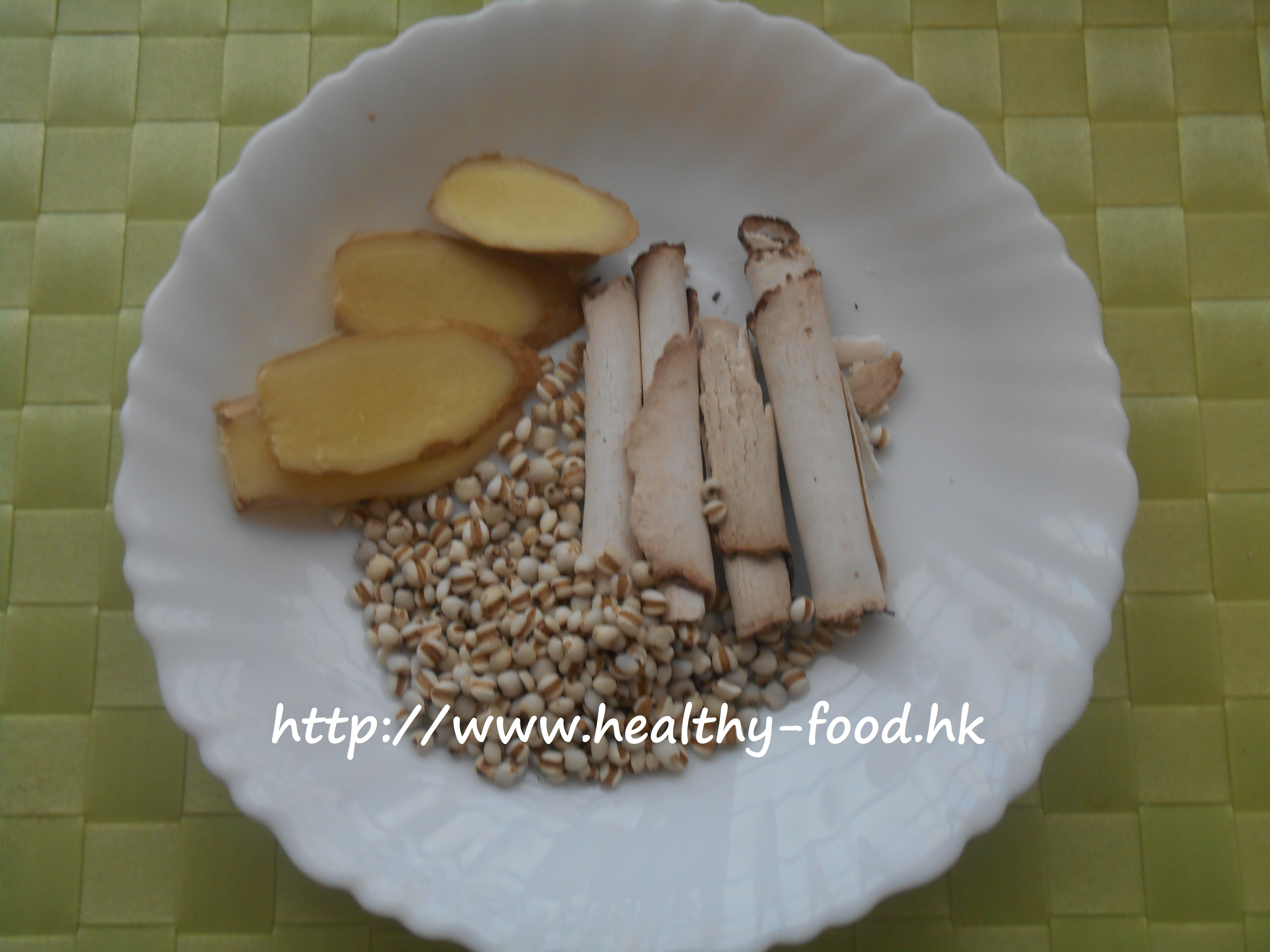
- Poria cocos (fu ling / Wolfiporia extensa): One of the most widely used tonics in Chinese food therapy. Traditionally considered neutral in temperature, it strengthens the spleen, calms the mind, and drains pathological dampness. Also associated with weight management.
- Raw Job’s tears (sheng yi mi / Coix lacryma-jobi): A well-known grain-herb used to drain dampness and heat from the body, support the spleen, and relieve fluid accumulation. Raw (untoasted) barley is cooler in nature and more draining; use it as directed rather than the toasted variety for this recipe.
- Fresh ginger (sheng jiang): Warming, aromatic, and digestive. It offsets any excessive cold quality of the other two ingredients and helps the body process dampness rather than simply pushing it around.
Ingredients (2 bowls)
| Ingredient | Amount | Notes |
|---|---|---|
| Poria cocos (fu ling) | ~18 g (5 qian) | Rinse and soak briefly |
| Raw Job’s tears (sheng yi mi) | ~38 g (1 liang) | Rinse and soak briefly |
| Fresh ginger | 3–4 slices | Skin on is fine |
| Water | 5 bowls (~1.2 L) |
Method
- Rinse the poria cocos and raw Job’s tears; soak for 20–30 minutes to shorten cooking time.
- Place all ingredients into a pot with 5 bowls of water.
- Bring to a boil, then reduce to a low simmer and cook for 1 hour until the liquid reduces to about 2 bowls.
- Strain or drink as is, including the softened Job’s tears (they are edible). Take once or twice daily.
Bro Niu’s tips
This tea is also beneficial for those with mild water retention and puffiness. However, the ginger makes it slightly warming — if your bad breath tends to be fiery and hot in character (think sore gums, mouth ulcers, a burning sensation), swap the ginger for 3 qian each of ophiopogon (mai dong) and rush pith (deng xin cao) to make it more cooling. Take it about 4 times per week — no need to drink it every single day.
Community questions answered (selected)
-
Q (PP): Can this tea be drunk daily? Bro Niu: Four times a week is plenty.
-
Q (Sophia): How do I know if I have stomach fire? Bro Niu: Common signs of stomach fire include swollen or inflamed gums, a tendency to develop mouth ulcers, and bad breath. If you have those symptoms together, stomach fire is likely the pattern.
-
Q (Wendy, from Canada): I often have a white tongue coating, intermittent constipation, and unformed stools. This has not improved much with Western medicine. What pattern might this be, and what food therapy can help? Also, what can substitute for winter melon if I cannot find it? Bro Niu: Your pattern sounds like spleen weakness with dampness. For winter melon you can use other mild diuretic vegetables like cucumber. To address the root issue, consider poria cocos, white atractylodes, and hyacinth bean coat as a base (this is the formula I recommend for spleen-damp patterns). Keep meals light, and avoid cold or raw foods.
Published November 13, 2016 · Adapted and translated for Nourilo from a traditional home-kitchen recipe. Approx. 3 min read.