Soups
Millettia Root (Niu Da Li), Fresh Yam and Chestnut Pork Shank Soup
traditionally used to strengthen sinews and tendons, support joint mobility, nourish the kidneys, and moisten the lungs
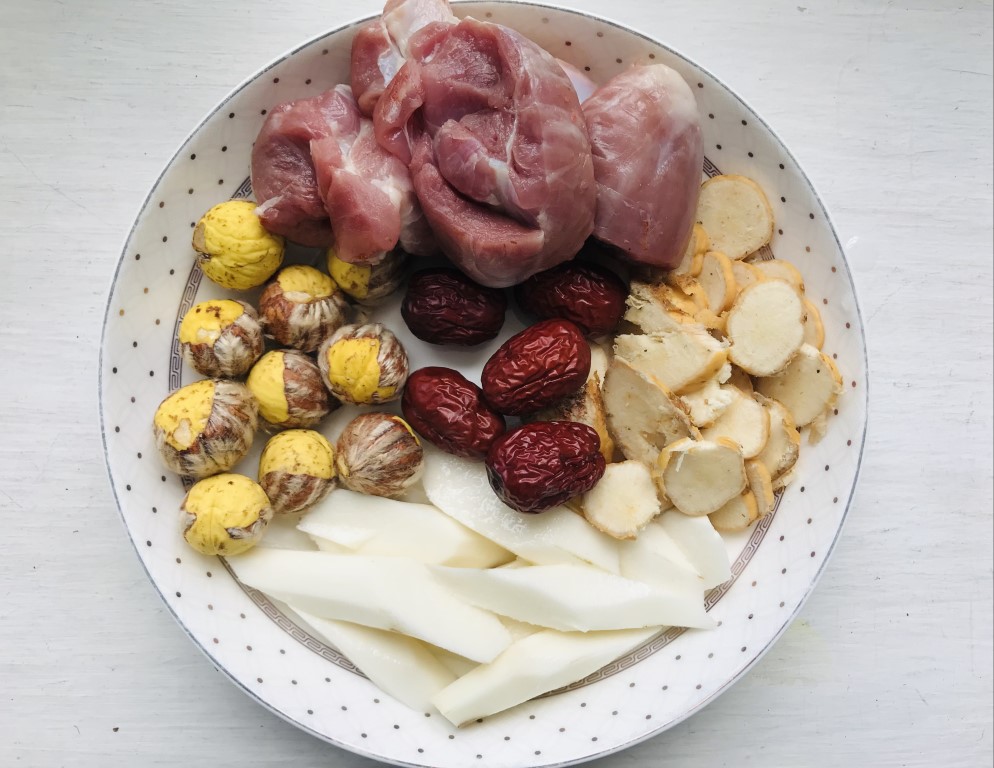
Why people make this soup
Millettia root (niu da li, literally “ox great power”) is a mild, warm root that stands apart from most mountain herbs in that it is not cooling or bitter. Traditional practitioners consider it one of the best non-drastic herbs for strengthening the sinews and tendons, supporting people with aching, stiff, or weak joints from rheumatic conditions, kidney deficiency, or simple overwork. Combined with fresh yam (strengthening to the spleen and kidneys), chestnuts (nourishing to the kidneys and tendons), and pork shank (collagen-rich protein), this soup is a delicious, deeply nourishing bowl for any family member dealing with joint complaints, persistent fatigue, or a weak constitution.
Who it suits / who should be cautious
- People with rheumatic joint pain, knee or lower-back weakness, or muscle soreness from over-exertion
- Those with a tendency toward chronic cough, mild lung weakness, or who work in smoky or polluted environments
- Suitable for the whole family as a general strengthening soup
- Dried millettia root (1 liang / ~40 g) can be substituted if fresh is unavailable — available at Chinese herbal pharmacies
Why these ingredients (the food-therapy logic)
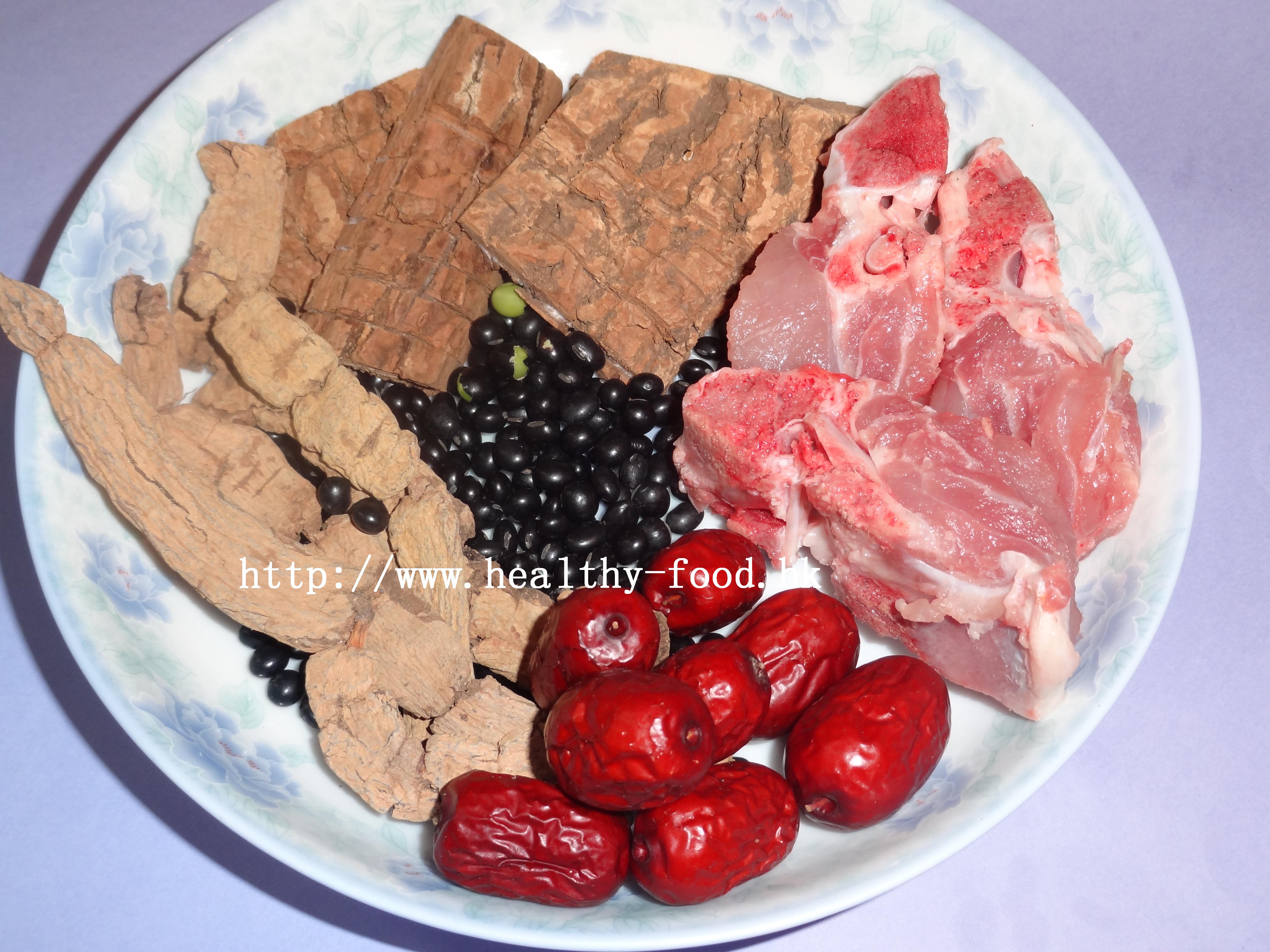
- Millettia root (niu da li): Warm in nature and non-irritating, unlike many cooling mountain herbs. Traditionally used to tonify deficiency, moisten the lungs, and strengthen sinews and bones. Particularly beneficial for rheumatic bone pain, chronic bronchitis, lung-related cough, and people who inhale smoke or fumes regularly.
- Fresh Chinese yam (xian huai shan): Gentle, starchy, and tonifying to the spleen, lungs, and kidneys. One of the most versatile and balanced tonic foods in the tradition.
- Chestnuts (li zi): Rich in complex carbohydrates and traditionally associated with nourishing the kidneys, strengthening the tendons and bones, and supporting the lower back.
- Red dates (hong zao): Blood-building, qi-tonifying, and they add natural sweetness to the broth.
- Pork shank: A gelatinous, collagen-rich cut that forms a hearty, nourishing broth — particularly supportive for joints and connective tissue.
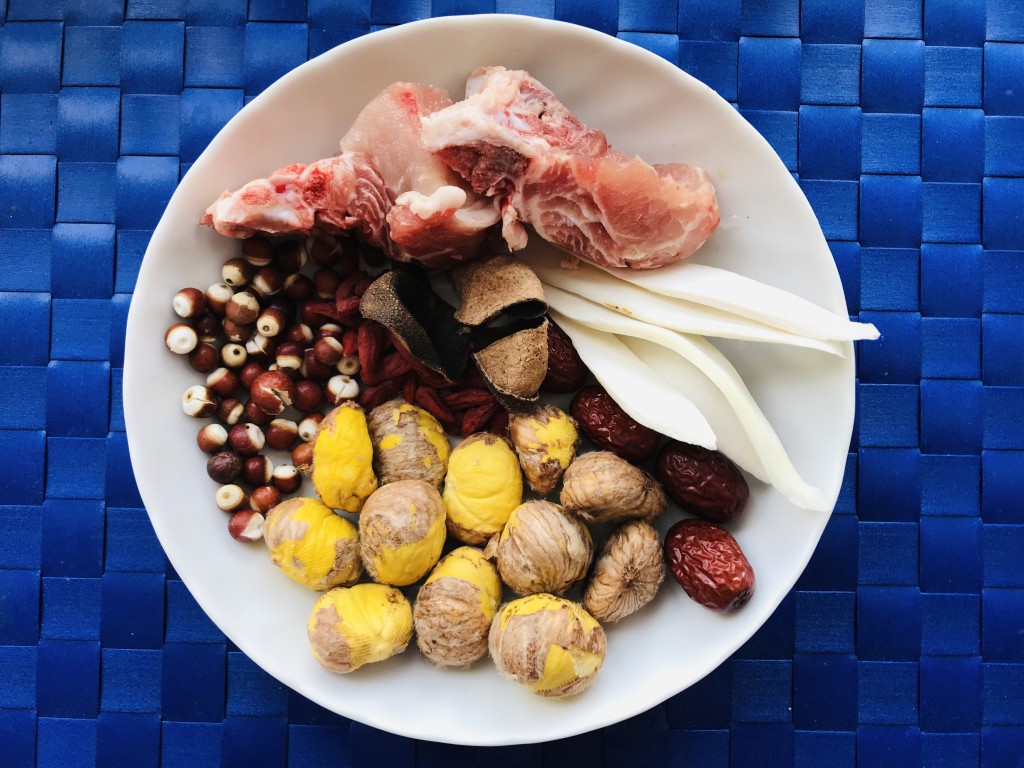
Ingredients (4 bowls)
| Ingredient | Amount | Notes |
|---|---|---|
| Fresh millettia root (niu da li) | ~80 g | Peel and slice thinly |
| Fresh Chinese yam (huai shan) | ~150 g | Peel and cut into chunks |
| Chestnuts | ~150 g | Blanch briefly to remove inner skin |
| Red dates | 6 pieces | Pit |
| Pork shank | 1 whole (~400 g) | Cut into pieces, blanched |
| Water | 8–9 bowls (about 1.6–1.8 L) |
Method
- Peel the fresh millettia root and slice thinly. Note: many Chinese herbal shops or Asian grocery stores carry it pre-skinned and sliced, which saves considerable prep time.
- Peel the fresh yam and cut into chunks (wear gloves if sensitive to yam mucilage).
- Drop chestnuts into boiling water for 1–2 minutes to loosen the inner skin; peel while warm.
- Pit the red dates.
- Blanch pork shank pieces in boiling water for 3 minutes; drain and rinse.
- Combine all ingredients in a large pot with 8–9 bowls of water. Bring to a boil.
- Reduce to a steady simmer and cook for 2 hours, until reduced to about 4 bowls.
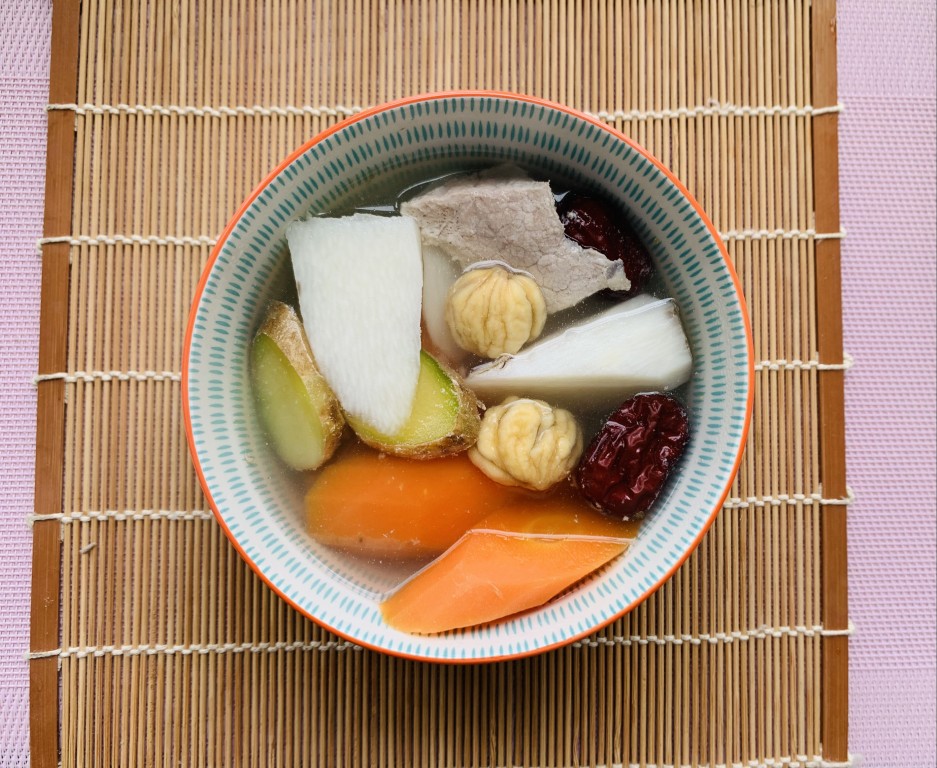
- Serve with all the solid ingredients — the yam and chestnuts especially are worth eating.
Bro Niu’s tips
Fresh millettia root is becoming easier to find at Asian grocery stores and Chinese herbal pharmacies. It is often available pre-skinned and sliced, saving a lot of prep time. If you cannot find it fresh, dried millettia root (~40 g / 1 liang) works equally well. For people suffering from chronic cough, smoker’s cough, or kitchen smoke irritation, try combining millettia root with sweet and bitter almonds, snow fungus, and dried figs instead — this variation emphasises the lung-moistening aspect.
Community questions answered (selected)
-
Q (Annie): I am in the US and cannot find fresh millettia root. Can I use dried? I have possible frozen shoulder — will this soup help? Bro Niu: Yes, use dried millettia root (~1 liang). For frozen shoulder, the salt-bag heat therapy is very effective: dry-toast 1 jin of coarse salt in a clean wok for 7 minutes, place in a pure cotton bag, put a thick towel over the shoulder first, then roll the hot bag over the painful area. Once it cools a little, remove the towel and apply directly. Once daily for three consecutive days gives good results. The salt bag can be reused — just re-toast the salt each time.
-
Q (Mio): Can dried millettia root be used instead of fresh? Is the effect the same? Bro Niu: Yes, dried root works well. Use about 1 liang. The effect is comparable.
Published October 12, 2022 · Adapted and translated for Nourilo from a traditional home-kitchen recipe. Approx. 4 min read.