Soups
Wheat Berry, Black Bean and Polygonum Vine Soup
traditionally used to calm the mind and support better sleep
Why people make this soup
We all know the feeling — the mind is running even when the body is tired, sleep is fragmented, and the next morning arrives before you feel ready. For many people, this kind of restless, anxious poor sleep — especially when accompanied by forgetfulness and mental fatigue — is a sign that the body’s resources have been stretched thin.
In traditional Cantonese food therapy, this pattern is often described as the heart and kidney “not communicating” — a state where the settling, cooling energy of the kidneys is not adequately nourishing the active, warming energy of the heart, leading to an unsettled mind. This soup aims to address that imbalance gently, nourishing both systems and giving the nervous system a chance to ease down.
Wheat berries are much more than flour — the whole grain contains the components that food therapists have valued for centuries for their calming action. Black beans nourish the kidneys. And the vine stem of the Polygonum plant has a different and gentler role than the root (which is primarily for liver-kidney tonification) — the vine is associated with calming the spirit and is used specifically for sleep support.
Who it suits / who should be cautious
- Suits those who experience difficulty falling asleep, restless or light sleep, excessive dreaming, forgetfulness, and mental fatigue — particularly when linked to overwork or prolonged stress.
- Also helpful for students under exam stress or for those who feel mentally drained.
- Suitable even during an ongoing mild cold, according to Bro Niu.
- Note: those with a very warm or overheated constitution (yin deficiency with excess fire) can also use this soup — it is generally considered balanced and not overly warming.
Why these ingredients (the food-therapy logic)
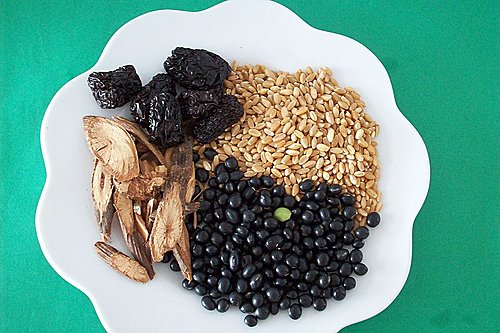
- Wheat berries (xiao mai mi): Whole, unprocessed wheat grain — not flour. In classical Cantonese food therapy, wheat is associated with calming the spirit, easing anxiety, and supporting heart function. A different category of action from millet or white rice.
- Black beans (hei dou): Traditionally associated with nourishing the kidney system, which in Chinese medicine thinking is linked to supporting the nervous system and overall vitality.
- Polygonum vine stem (ye jiao teng): The vine (stem) of the he shou wu plant (Polygonum multiflorum). Important note: this is the stem, not the root — the root (he shou wu) is primarily used for hair and liver-kidney tonification, not sleep. The vine is specifically associated with calming the mind and supporting sleep. It can also be used externally as a wash for itchy skin conditions.
- Southern jujubes (nan zao): Mildly sweet; traditionally associated with nourishing the blood, calming the spirit, and supporting restful sleep.
- Slab sugar (pian tang): Adds a gentle sweetness to balance the slight earthiness of black beans and wheat.
Ingredients (2 bowls / 1 serving)
| Ingredient | Amount | Notes |
|---|---|---|
| Wheat berries (whole wheat grain) | ~38 g (1 liang) | Rinse well; soak 30 min if preferred |
| Black beans | ~38 g (1 liang) | Rinse; no need to pre-soak |
| Polygonum vine stem (ye jiao teng) | ~19 g (5 qian) | Available at Chinese herb shops |
| Southern jujubes (nan zao) | 6 pieces | |
| Slab sugar (pian tang) | To taste | Add at the end and dissolve |
| Water | 6 bowls (~1.5 L) |
Method
- Rinse wheat berries, black beans, jujubes, and polygonum vine thoroughly.
- Combine all ingredients (except the sugar) in a pot with 6 bowls of water.
- Bring to a boil over high heat, then reduce to a gentle simmer.
- Cook for about 1.5 hours, until reduced to approximately 2 bowls.
- Add slab sugar and stir until dissolved.
- Take one serving as a daily dose. Drink one bowl in the morning and one bowl in the afternoon or early evening. Make a fresh batch each day and continue for one week.
Bro Niu’s tips
Wheat berry (xiao mai mi) is the whole wheat seed — in English it is sometimes labelled “wheat berry” or “wheat grain.” It is different from processed wheat or oats. The polygonum vine stem is the part of the plant used for sleep — not the same as the root (he shou wu), which has a different function. If you cannot find polygonum vine, Bro Niu suggests substituting dried jujube kernel (suan zao ren) at 3 qian, or lily bulb (bai he) at 1 liang — both are associated with supporting sleep. This soup is particularly helpful for students under exam pressure and for those whose minds stay active even when they are physically tired.
Community questions answered (selected)
-
Q (Connie): I have yin deficiency with excess fire and also urticaria. Can I drink this soup? Is the recipe for one person? Bro Niu: Yes, those with yin deficiency with excess fire can take this soup — it is suitable. And yes, the recipe makes one person’s serving.
-
Q (scy): Can I substitute he shou wu (Polygonum root) for ye jiao teng if I cannot find the vine? Bro Niu: If you cannot find the vine, use suan zao ren (dried jujube kernel) at 3 qian, or bai he (lily bulb) at 1 liang instead. Both support sleep well. He shou wu (the root) primarily nourishes the liver and kidney and darkens hair — it has less direct sleep-supporting action.
-
Q (Friend): The recipe makes 2 bowls — do I drink both at once, or split them? Bro Niu: Drink one bowl each time, splitting the 2 bowls between morning and afternoon on the same day. That is your daily dose.
Published October 25, 2013 · Adapted and translated for Nourilo from a traditional home-kitchen recipe. Approx. 4 min read.