Home-Style Dishes
He Shou Wu, Goji and Four-Herb Chicken Stew
traditionally used to nourish liver blood, support healthy hair and complexion
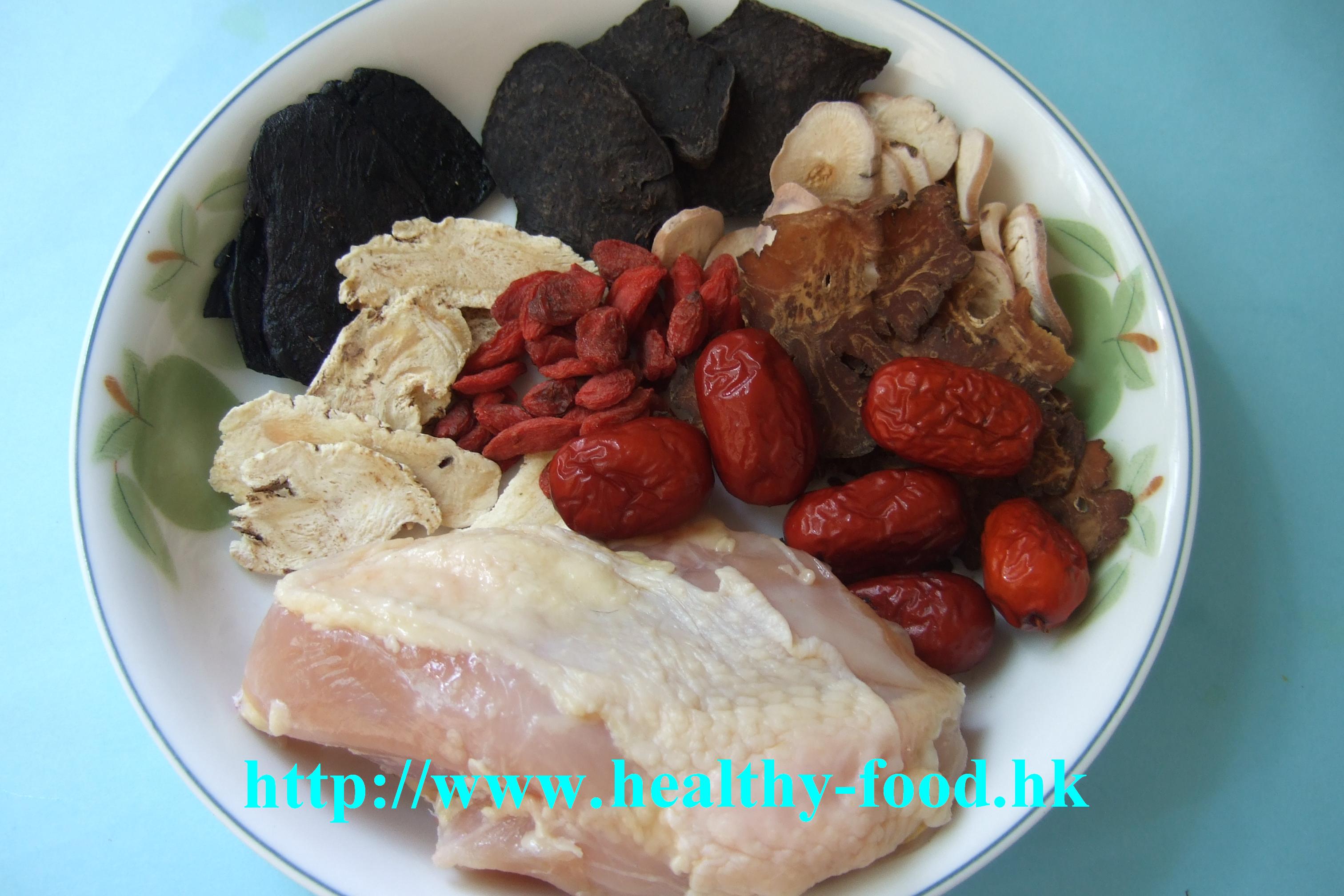
Why people make this stew
Some signs that tend to appear earlier than expected — a dull complexion, premature grey strands, hair that lacks body, a general flatness of energy, or joints that feel less comfortable than they should — can point, in the framework of traditional Chinese food therapy, to what practitioners call liver blood deficiency. The classic four-herb formula, si wu tang, has been used for centuries in this context: dong quai to move and nourish blood, white peony to gently soften and regulate, sichuan lovage to promote circulation, and rehmannia to provide deep nourishment. In this stew, that classic base is enhanced with he shou wu (the herb most closely associated in Chinese tradition with hair darkening and kidney-liver support) and goji berries. The result is a rich, double-boiled stew with a distinctive herbal aroma and a flavour that is more pleasant than you might expect from such a medicinal-looking ingredient list.
Who it suits / who should be cautious
- People experiencing premature grey hair, hair thinning, tired eyes, pale complexion, soft aching in the lower back and knees, or fatigue associated with blood deficiency
- Women in the week or two after menstruation who wish to replenish
- Suitable for most adults as a periodic tonic (2 times per week is a reasonable frequency)
- Do not take during menstruation
- Not suitable during illness, fever, or cold/flu
- Pregnant women should consult a practitioner before taking this stew
- Children are generally not recommended for this type of tonic; it may over-stimulate developing systems
- People who tend toward acne or heat-related conditions should start at reduced amounts (half the herbs) and assess their response before increasing
- Women with uterine fibroids can take this stew, but omit the dong quai and replace with a few pieces of longan (yuan rou)
Why these ingredients (the food-therapy logic)
- He shou wu, prepared (zhi he shou wu): One of the most revered herbs in traditional Chinese practice for liver and kidney support, hair darkening and anti-ageing; the “prepared” (zhi) form is processed with black beans and is considered safer and more suitable for regular use than the raw (sheng) form — always use the prepared version
- Goji berries (gou qi zi): Nourish liver and kidney, support clear vision, gently build blood
- Dong quai (dang gui): A classic blood-moving and nourishing herb; supports circulation and helps with the mild aching associated with blood deficiency
- White peony root (bai shao): Nourishes blood, softens the liver, eases tension
- Sichuan lovage root (chuan xiong): Activates blood circulation, enhancing the effectiveness of the other blood-nourishing herbs
- Prepared rehmannia (shu di): The primary deep blood-nourishing herb in the four-herb formula; rich and strengthening
- Red dates (hong zao): Support digestion and blood production; add gentle sweetness
Ingredients (3–4 bowls)
| Ingredient | Amount | Notes |
|---|---|---|
| He shou wu, prepared (zhi he shou wu) | 19 g (5 qian) | Must be the prepared, not raw, form |
| Goji berries | 15 g (4 qian) | Rinse before use |
| Chuan xiong (Sichuan lovage) | 7.5 g (2 qian) | |
| Dang gui (dong quai) | 11 g (3 qian) | Omit for uterine fibroids; replace with longan |
| Bai shao (white peony) | 11 g (3 qian) | |
| Shu di (prepared rehmannia) | 19 g (5 qian) | |
| Red dates | 6 pieces | |
| Chicken pieces | 300 g | Blanch briefly, rinse and drain before use |
Method
- Blanch the chicken pieces in boiling water for 2 minutes. Rinse with cold water and set aside.
- Rinse all dried herbs and soak briefly in cold water.
- Place all ingredients into a double-boiler pot (dun zhong). Pour boiling water over the ingredients to fill the pot.
- Set the inner pot into the outer pot of boiling water. Cover and double-boil (dun) for approximately 3 hours.
- Alternatively, if using a regular pot: combine everything with 8 bowls of water, bring to a boil, then simmer over low heat for 2 hours until the liquid reduces to 3–4 bowls.
- Drink the broth warm. The dates and goji berries can also be eaten.
Bro Niu’s tips
- The four herbs — chuan xiong, dang gui, bai shao and shu di — form the classical formula known as si wu tang, which has been used for centuries to nourish blood and vitality. This stew will have a noticeable herbal taste, but most people find it pleasantly deep and warming rather than unpleasant.
- If you tend to heat up easily or develop breakouts after taking rich tonic soups, start with half the herb quantities and see how your body responds before increasing.
- Women with uterine fibroids: remove dong quai from the recipe and add a few pieces of longan (yuan rou) instead — the soup remains nourishing without the blood-moving action that is best avoided with fibroids.
- The stew can be cooked in a pot rather than double-boiled — simply use 8 bowls of water and simmer for 2 hours.
Community questions answered (selected)
-
Q (winnie): I have qi and blood deficiency, heavy periods, dizziness and tinnitus. Can I drink this stew? Bro Niu: Yes, you can drink this — but during menstruation you should stop and wait until your period has ended before resuming. Try twice a week for two to three weeks and see if there is improvement.
-
Q (meimei): I tend toward heat, have poor digestion, thin menstrual flow and cold hands and feet. Can I take this stew or the eight-treasure formula (ba zhen tang)? Bro Niu: Both formulas are very nourishing for blood and qi, but they can be warming and may cause discomfort if your constitution tends toward heat. I suggest starting at half the herb quantities and monitoring how you feel. You can use raw rehmannia (sheng di) in place of prepared rehmannia if heat is a concern, as it has a cooling quality.
-
Q (LAM LAM MA): Can I take this stew after my period? How many times a week is suitable? Bro Niu: Yes — after menstruation ends is the ideal time to take this stew. Twice a week is a good frequency. The difference between si wu tang (four herbs) and ba zhen tang (eight treasures) is that the eight-treasure formula adds four qi-tonifying herbs to the blood-nourishing four; it is richer and more comprehensive but will have a stronger herbal flavour.
Published November 22, 2011 · Adapted and translated for Nourilo from a traditional home-kitchen recipe. Approx. 5 min read.