Home-Style Dishes
Braised Fish Maw with Broccoli & Flower Mushrooms
Traditionally used to support the spleen, stomach, and kidney vitality through collagen-rich fish maw
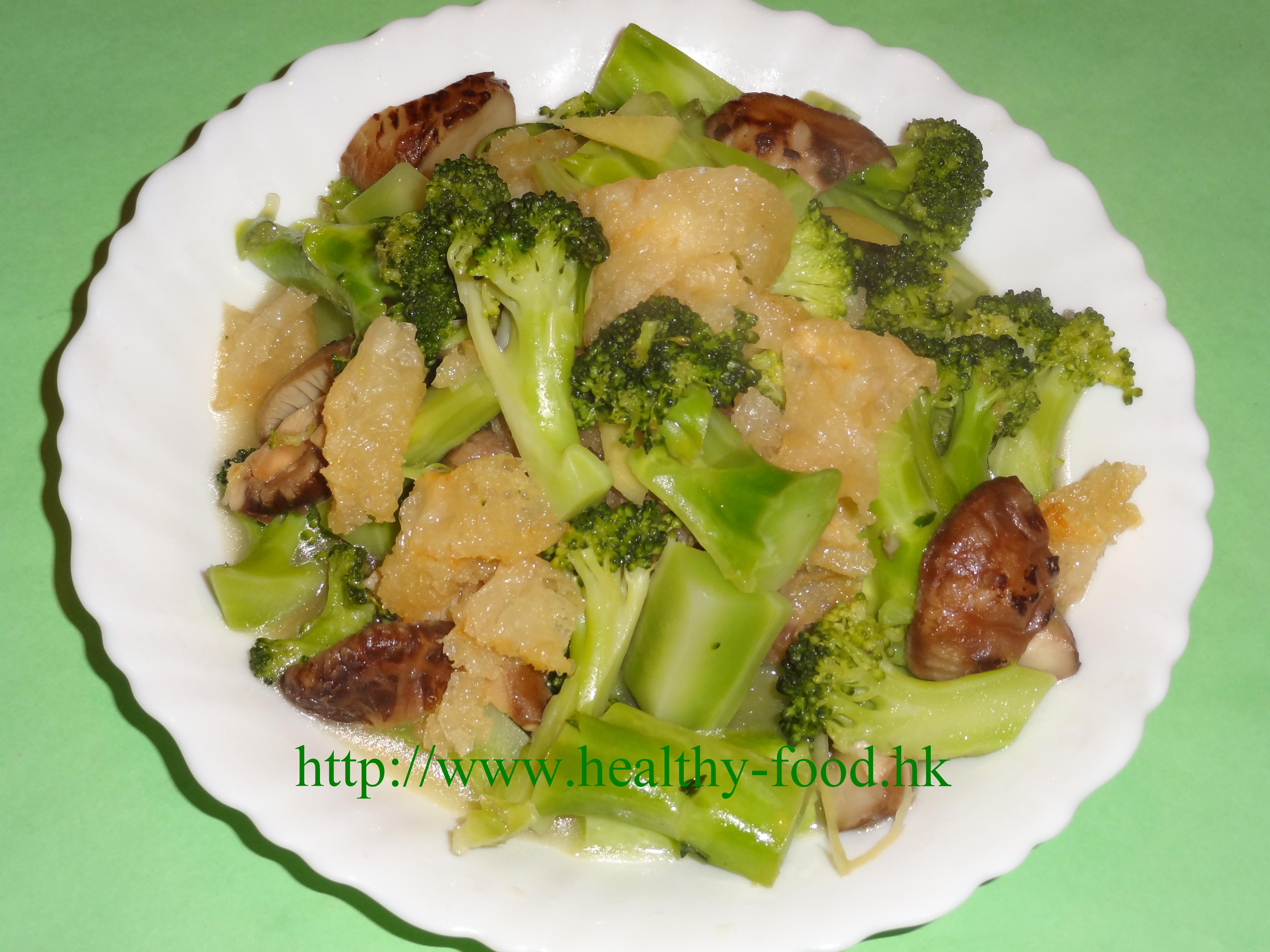
Why people make this dish
Bro Niu has fond memories of going to yum cha as a child and ordering “cotton chicken” (mian hua ji) — the part he loved most was the soft, spongy puff of fish maw that had absorbed all the savory chicken broth. That same ingredient, sand-puffed fish maw, transforms into something wonderfully silky once rehydrated and braised. On a trip to the dried seafood street, Bro Niu picked up several large pieces and decided to braise them simply with broccoli and flower mushrooms at home — no chicken needed, and equally delicious.
Who it suits / who should be cautious
- A nourishing, collagen-rich dish suitable for most adults and the elderly
- Traditionally considered beneficial for those who need to nourish the kidneys and support healthy skin and joints
- Fish maw is not a “stimulating food” (fa wu), making it more broadly suitable than some other sea products
- This dish can be adapted for postpartum recovery — it makes an excellent braised dish alongside other postnatal soups
- Those with seafood allergies should use caution
Why these ingredients (the food-therapy logic)
- Fish maw (yu du): Dried swim bladder of fish; one of the four traditional Chinese “great tonics” (along with abalone, sea cucumber, and shark fin); extremely rich in collagen; traditionally associated with nourishing the kidneys, supporting reproductive essence (jing), and improving skin quality. Sand-puffed fish maw (sha bao) is the more accessible and affordable variety — choose pieces that are white, thick, and odor-free
- Flower mushrooms / shiitake (hua gu): Widely regarded as a health-supporting food in both Chinese and modern nutritional traditions; traditionally associated with supporting the spleen and stomach, and boosting immunity
- Broccoli (xi lan hua): Rich in vitamins C and K, folate, and antioxidants; traditionally considered beneficial for the stomach and spleen; adds fresh color and texture to balance the richness of the fish maw
Ingredients (2–3 servings)
| Ingredient | Amount | Notes |
|---|---|---|
| Sand-puffed fish maw (sha bao yu du) | 1–2 pieces (40–60 g dry) | Soak in water until softened; blanch in ginger water |
| Broccoli | 1 head | Cut into small florets |
| Dried flower mushrooms (shiitake) | 6 small pieces | Soaked until soft, stems removed, sliced |
| Ginger, shredded | 1 tablespoon | |
| Stock or broth | half a bowl (approx. 120 ml) | Good-quality stock makes a big difference |
| Shaoxing wine | a splash | |
| Salt, soy sauce, oyster sauce | to taste | |
| Cooking oil | for frying |
Method
- Soak the dried fish maw in cold water until it becomes soft and pliable. Cut into smaller pieces. Blanch briefly in a pot of water with a few slices of ginger to remove any fishiness; drain and set aside.
- Soak the dried flower mushrooms until soft; remove stems and slice.
- Wash and cut the broccoli into small florets.
- Heat oil in a wok or wide pan. Fry the shredded ginger until fragrant. Add the broccoli florets and sliced mushrooms; stir-fry for about a minute.
- Add the fish maw pieces. Pour in a splash of Shaoxing wine, then add the stock and seasoning.
- Braise over medium heat for about 12 minutes until most of the liquid is absorbed and the sauce coats the ingredients.
- Plate and serve immediately.
Bro Niu’s tips
Choose sand-puffed fish maw that is snow-white, thick, and has no off-putting smell. Fish maw has very little flavor of its own — it must be braised in a good stock (or chicken broth) to taste truly wonderful; it absorbs the surrounding flavors like a sponge. Don’t let it sit in the braising liquid for too long after cooking, as it will become waterlogged.
Community questions answered (selected)
-
Q (yan): My mother recently has swollen, painful hands. The doctor suspects rheumatoid arthritis. What soup would you suggest? Bro Niu: Rheumatoid arthritis tends to flare in cold weather. Try: jade bamboo (yu zhu) 19 g, Chinese angelica (dang gui) 8 g, cinnamon twig (gui zhi) 8 g, red dates 6 pieces, ginger 3 slices, goji berries 15 g — braise with lamb leg bones in 8 bowls of water for 2 hours until it reduces to 4 bowls. Drink over 2 days; repeat for 2 doses (4 days total) and see whether there is improvement.
-
Q (家碧): My mother is in her 80s and has had dizziness and inner ear imbalance for two weeks. The medication helped a little but she still gets dizzy when lying down. What should she eat? Bro Niu: Try: fa xia (pinellia) 8 g, fu ling (poria) 15 g, chen pi (tangerine peel) 8 g, bai zhu (white atractylodes) 8 g, tian ma (gastrodia) 8 g, wu mei (black plum) 2 pieces, ginger 3 slices — in 5 bowls of water, simmer to 2 bowls. Take 3 consecutive doses. If it improves, rest 3 days then take another course. This formula is traditionally used to support inner ear balance issues.
Published December 12, 2012 · Adapted and translated for Nourilo from a traditional home-kitchen recipe. Approx. 4 min read.