Herbal & Flower Teas
Angelica and Motherwort Egg Tea
traditionally used to invigorate blood, regulate menstruation, and support fading of postpartum skin spots
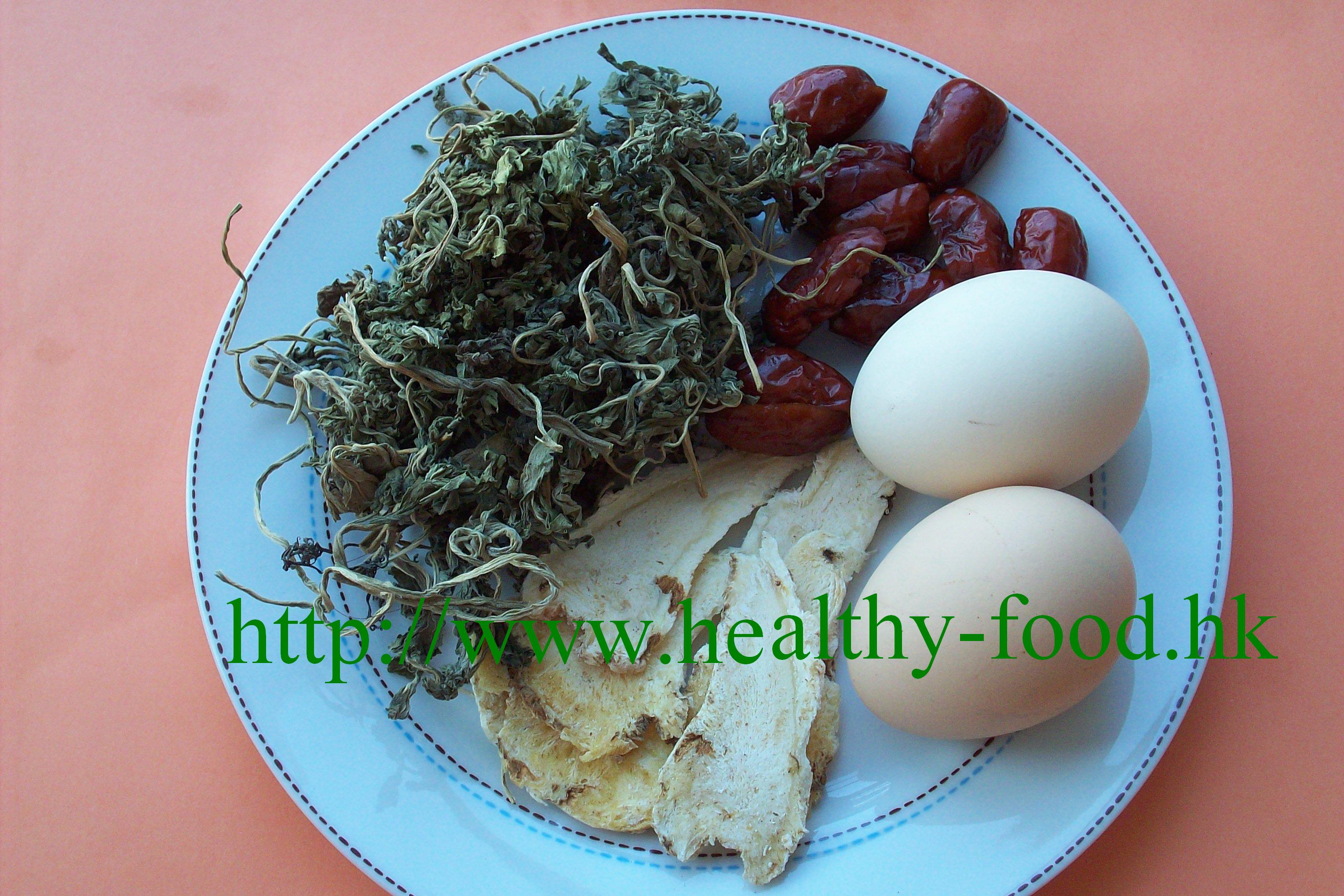
Why people make this tea
After childbirth, some women notice brownish patches appearing on their cheeks — a form of skin pigmentation called chloasma or melasma. In traditional Chinese food therapy, this is often linked to qi stagnation and blood stasis in the liver: the body’s circulatory energy has been disturbed by the physical demands of pregnancy and delivery, and the resulting sluggishness in blood flow shows up on the face. The same pattern can show up as moodiness, chest tightness, irregular periods, and a general sense of emotional heaviness. Motherwort (yi mu cao) is one of the most highly regarded herbs for women’s health in Chinese tradition — it moves blood, reduces water retention, and supports uterine recovery. Paired with angelica (dang gui), which nourishes and moves blood simultaneously, and red dates for gentle nourishment, this tea works on the underlying circulation rather than just the surface appearance. Fresh motherwort is available at Chinese or Asian grocers when in season; dried motherwort is available year-round at Chinese herb shops and online.
Who it suits / who should be cautious
- Suited for postpartum women (after lochia has substantially cleared) experiencing skin spots, mood changes, or irregular periods
- Also helpful for women generally who have irregular periods or mild menstrual irregularity linked to blood stagnation
- PREGNANT WOMEN must NOT use this — motherwort and angelica are contraindicated in pregnancy
- Not to be used while postpartum bleeding or lochia is still heavy; wait until discharge has largely stopped before starting
- If breastfeeding, consider taking the tea after nursing rather than before, as angelica has a strong aroma that some babies may refuse
- Women with early miscarriage (xiao chan): Bro Niu notes this tea can be started from the second day, with red sugar added for extra warming and blood-moving benefit
Why these ingredients (the food-therapy logic)
- Chinese angelica root (dang gui): The most important blood-nourishing herb in Chinese food therapy; simultaneously nourishes and invigorates blood — it fills the blood while also moving it to prevent stagnation
- Motherwort herb (yi mu cao): Specifically targeted at the uterus and female reproductive system; traditionally used to regulate menstruation, reduce postpartum blood stagnation, relieve water retention, and mildly lower elevated blood pressure
- Red dates (hong zao): Nourish the blood and calm the mind; add gentleness and natural sweetness to balance the stronger moving herbs
- Egg: Nourishes and anchors the body’s nourishing resources (yin); acts as a grounding food alongside the circulatory herbs
Ingredients (1–2 servings)
| Ingredient | Amount | Notes |
|---|---|---|
| Chinese angelica root (dang gui) | ~11 g (3 qian) | Rinse |
| Motherwort (yi mu cao) — fresh | ~75 g (2 liang) | Or use dried: ~38 g (1 liang) |
| Red dates, pitted | 8 pieces | Rinse |
| Egg | 1 | Hard-boil first, then shell |
Method
- Hard-boil the egg, cool it under running water, and peel the shell.
- Rinse the angelica root, motherwort (fresh or dried), and red dates.
- Place the angelica, motherwort, and red dates in a pot with enough water to cover (about 4 bowls). Bring to a boil, then reduce heat and simmer for 45 minutes.
- Add the peeled hard-boiled egg and continue to simmer for a further 5 minutes.
- Drink the tea and eat the egg. Red sugar (hong tang) can be added for additional warming effect.
Bro Niu’s tips
- Fresh motherwort is considered a first-year “virgin” plant (tong zi yi mu cao); the dried herb is usually a two-year-plus plant and is considered more potent but has a more bitter taste. To make dried motherwort more palatable, add 3 to 4 slices of ginger and a little red sugar while brewing
- Red sugar (hong tang / unrefined cane sugar) can be added to help warmth, invigorate blood, and make the tea more pleasant to drink
- This tea also helps with menstrual irregularity in general, not just postpartum
- If lochia is still flowing, do not rush to use this tea — allow the body its natural recovery time first
Community questions answered (selected)
-
Q (Yee): I am 20 days postpartum and my lochia has suddenly increased and turned bright red. Can I use fresh motherwort to help clear it? Bro Niu: Has anything changed — did you catch a chill, or start taking tonics too early? Taking supplements before lochia has fully cleared can actually interfere with its clearance. Fresh motherwort can be used, but dried motherwort is usually more effective. To make the taste easier, add 3 to 4 slices of ginger and a little red sugar. Brew for three consecutive doses and see if it improves.
-
Q (Lily): My period has been coming every 20 days. Can I drink this angelica and motherwort egg tea? Bro Niu: This tea mainly invigorates blood and regulates the cycle. Periods that come early are usually due to qi deficiency or blood heat. You might also try: golden needle (jin zhen, 3 qian), black wood ear (hei mu er, 2 pieces), and celery (xiang qin, 2 liang) simmered into a pork soup — two doses per week. For qi deficiency, a soup of astragalus (bei qi), codonopsis (dang shen), yam (huai shan), and red dates with black chicken works well — two doses per week until the next period comes.
-
Q (Dan): My sister has G6PD (favism). Can a G6PD mother who has just given birth drink this motherwort tea? Bro Niu: Yes, a mother with G6PD can drink this tea.
Published July 13, 2012 · Adapted and translated for Nourilo from a traditional home-kitchen recipe. Approx. 4 min read.