Congee & Porridge
Aged Tangerine Peel, Apricot Kernel and Barley Congee
Traditionally transforms phlegm, harmonizes the stomach and eases dizziness
Why people make this congee
In Chinese thinking, dizziness often traces back to the liver and can arise from several roots — wind, fire, phlegm or depletion. For the kind that comes with a heavy, foggy head, chest stuffiness, nausea or queasiness — the “phlegm-damp obstruction” pattern — Bro Niu likes a gentle medicinal congee that transforms phlegm and settles the stomach. This one is traditionally said to clear heat, transform phlegm, move the qi and harmonize the stomach, easing that thick-headed, phlegmy dizziness.
Who it suits / who should be cautious
- Suits people with phlegm-related dizziness — a heavy, foggy head, chest fullness and a tendency to nausea or queasiness, often with a lot of phlegm.
- Apricot kernels must be cooked, never eaten raw. Job’s tears barley is best avoided in early pregnancy as it may cause slight uterine contraction. Dizziness can have serious medical causes; if it is severe, recurring, or accompanied by vomiting — especially in older adults or those with high blood pressure — please see a doctor.
Why these ingredients (the food-therapy logic)
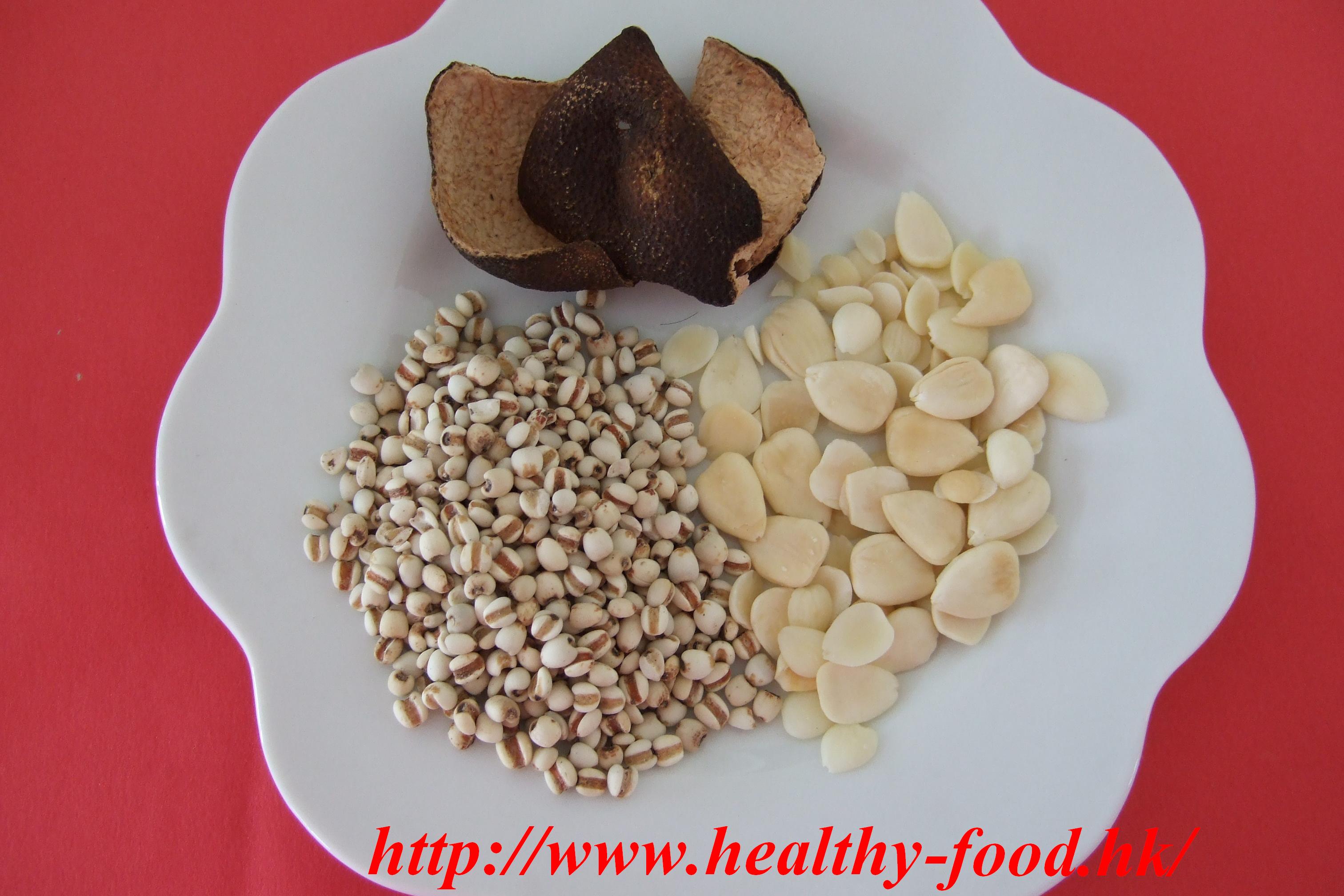
- Aged tangerine peel (chen pi): traditionally used to move the qi, transform phlegm and harmonize the stomach.
- Apricot kernels (nan bei xing): traditionally associated with the lungs and with transforming phlegm; cook them, do not eat raw.
- Job’s tears barley (yi mi): traditionally used to clear heat and drain dampness, supporting the spleen.
- White rice (bai mi): the gentle, easy-to-digest congee base.
Ingredients (2–3 bowls)
| Ingredient | Amount | Notes |
|---|---|---|
| Aged tangerine peel (chen pi) | 3 qian (~11 g) | |
| South & north apricot kernels | 5 qian (~19 g) | Always cooked |
| Job’s tears barley (yi mi) | 1 liang (~38 g) | Avoid in early pregnancy |
| White rice | 2 liang (~75 g) |
Method
- Rinse and soak all the ingredients.
- Add water and simmer into a congee of medium thickness.
- Eat as much as you like; the source suggests taking it for about a week.
Bro Niu’s tips
You can also add poria (fu ling) and white atractylodes (bai zhu), 4 qian each, to this congee — the source notes this is also helpful for people with inner-ear imbalance (vertigo). For raw versus cooked barley: you can mix both; if the person eating it has a weaker, cooler spleen and stomach, add some cooked barley, which strengthens the spleen more.
Community questions answered (selected)
- Q (Ke Ke): Is there a raw and cooked kind of barley? Which should this congee use? Bro Niu: You can put both raw and cooked barley together. Mainly, if the person eating it has a weaker, cooler spleen and stomach, add some cooked barley, as it is stronger at strengthening the spleen.
- Q (He Ning): I haven’t been making soup lately — if I don’t make congee, would adding lean pork give the same effect? Bro Niu: Yes, you can add lean pork and cook it as a soup.
- Q (Yuki Lam): My 70-year-old relative has inner-ear imbalance, frequent dizziness and high blood pressure — what can I simmer to help? Bro Niu: Try pinellia (fa xia), poria (fu ling), white atractylodes (bai zhu) and gastrodia (tian ma) — 3 qian each — with 2 qian aged tangerine peel, 5 bowls of water simmered 1 hour down to 2 bowls, taken for 3 doses; if it helps, rest 2 days then repeat a course. (A traditional formula — please have a doctor confirm it suits the person.)
Published September 16, 2011 · Adapted and translated for Nourilo from a traditional home-kitchen recipe. Approx. 3 min read.